
Manufacturing Closeout: Why Finished Work Still Gets Stuck Before Invoice
Finished on the floor is not always finished for the business. Closeout readiness turns production evidence into shipment and invoice confidence.
TL;DR
Many shops lose time after production is complete.
The part is done, but the job is not closed. QC signoff is unclear. Shipment details are missing. The customer PO reference is buried. A partial quantity changed. The invoice waits because the office has to reconstruct what happened.
That is a manufacturing closeout problem.
AIURION supports production completion, QC, packaging or shipping, order context, and invoice records in the same operating workflow. The closeout packet and invoice-ready marker remain a deliberate shop convention today, not a native workflow state.
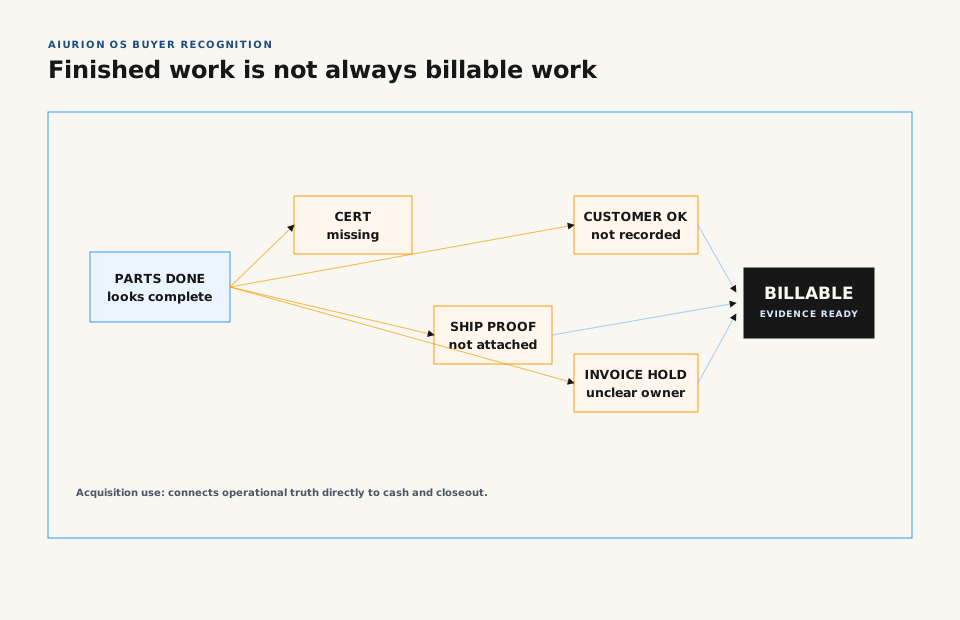
Diagram: Finished work can still leave cash stuck when closeout evidence is missing.
Skip Ahead
- The false finish line
- What closeout should verify
- A copyable closeout packet
- A stuck-invoice example
- The metric to watch
- Where AIURION OS fits
- Your next move
The False Finish Line
Production completion feels like the finish line.
For the business, it often is not.
The job may still require:
- final inspection
- certs or inspection records
- customer notification
- packaging or shipment confirmation
- outside process documentation
- partial shipment decision
- quantity reconciliation
- invoice line details
- exception notes
When those items are not tied to the job record, finished work can sit.
That delay is easy to miss because it does not always show up as production lateness. It shows up as slow cash conversion, office follow-up, customer confusion, and end-of-month cleanup.
What Closeout Should Verify
Manufacturing closeout should answer three questions:
- Is the job physically complete?
- Is the job quality-complete?
- Is the job commercially complete?
Those are different states.
| State | Evidence Needed |
|---|---|
| Physically complete | quantity, operation completion, rework status |
| Quality-complete | inspection signoff, exceptions, required documents |
| Shipment-ready | packaging, destination, partial shipment decision |
| Invoice-ready | customer PO, shipped quantity, price, tax/freight context |
| History-ready | notes that should inform repeat work or future quotes |
The job should not depend on one person's memory to move from one state to the next.
NIST's digital-thread work frames the value of information continuity across lifecycle stages [S1]. Closeout is a practical lifecycle stage that many shops under-design.
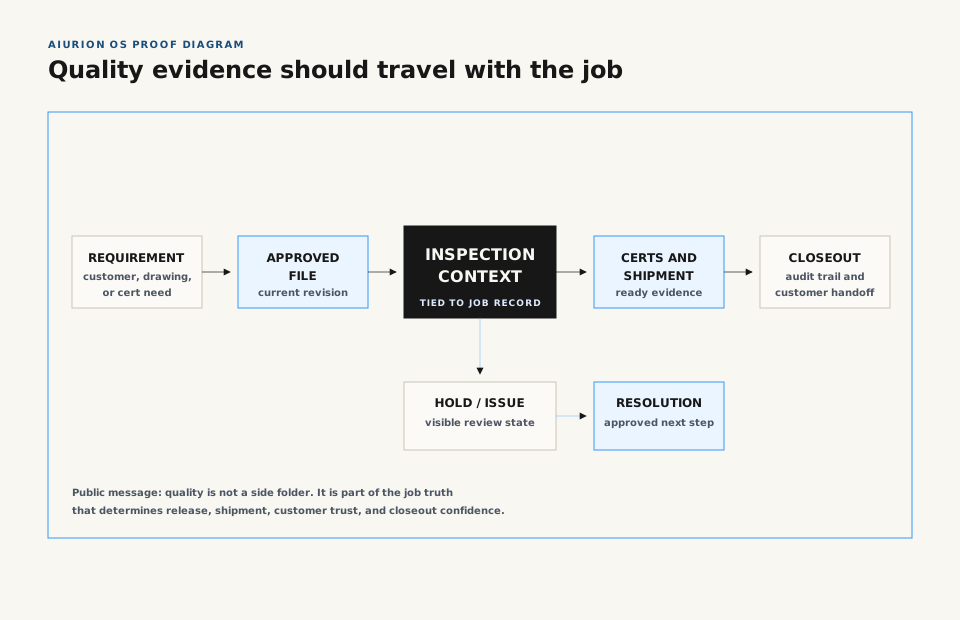
Diagram: Quality evidence should travel with the job.
A Copyable Closeout Packet
Use one closeout packet for every job, even if the fields are implemented as a disciplined note or review today.
| Closeout check | Evidence to record | Accountable owner |
|---|---|---|
| operations complete | final required operation complete; accepted and scrap quantities recorded | production |
| quantity reconciled | ordered, produced, accepted, held, scrapped, and shipped quantities agree or have an approved exception | production / office |
| QC complete | required checks are Pass or N/A; measurements, inspector, and issue/action notes are present | quality |
| rework resolved | reopened or corrected operations are complete and their reasons remain in history | production / quality |
| documents present | required certificate, inspection report, or customer document is attached or referenced | quality / office |
| packaging and shipment decided | packaging state, destination, shipped quantity, and partial-shipment approval are explicit | shipping / office |
| commercial terms confirmed | customer PO, price, freight, tax, and invoice quantity match the approved order | office |
| customer exception closed | any deviation, partial shipment, or delivery change has an approved and preserved customer response | account owner |
| invoice handoff complete | invoice exists in the correct status or the owner has everything needed to create it | billing |
"Invoice-ready" should mean every required row is complete or has an approved exception. It should not mean only that the parts left the machine.
A Stuck-Invoice Example
Imagine a job for 40 machined housings.
The floor completes 40. QC passes 38 and holds 2 for minor rework. The customer has approved partial shipment in the past, but not on this PO. The office sees the job as complete in a production note but cannot tell whether to invoice 38, wait for 40, or ask the customer.
The delay is not an accounting problem.
It is a missing closeout record.
A better closeout state would show:
- 40 produced
- 38 passed final inspection
- 2 held for rework
- customer partial shipment approval not confirmed for this order
- shipping blocked pending approval
- invoice readiness blocked behind shipment decision
- customer update owner assigned
Now the next action is obvious. Without that record, the office starts asking around.
The Metric To Watch
Closeout deserves its own operating metric:
time from production complete to invoice-ready.
This is a derived operating metric, not a native AIURION KPI today. Define the two timestamps before comparing jobs:
- production-complete timestamp: the final required operation is complete and accepted quantity is recorded, after any required correction
- invoice-ready timestamp: a person verifies the closeout packet and records that all required evidence or approved exceptions are present
Then calculate:
closeout delay = invoice-ready timestamp - production-complete timestamp
Example: production completes Friday at 2:20 p.m. The office verifies the packet Monday at 9:05 a.m. The elapsed closeout delay is 66 hours 45 minutes. If the shop prefers working-hours analysis, define that calculation separately and do not mix it with elapsed time.
Do not measure only ship date or invoice date. The derived gap measures the time between finished execution and a responsible billing handoff.
That gap reveals hidden friction:
- QC records that are not attached
- partial quantities that are not reconciled
- shipment decisions that are not owned
- customer approvals that are not preserved
- invoice details that require manual lookup
- exceptions that live in conversation instead of history
If the gap is short and consistent, the closeout process is probably healthy. If the gap varies by job, customer, or person, the shop is relying on memory instead of a closeout standard.
Where AIURION OS Fits
AIURION supports the closeout handoff through connected order, traveler, Production, QC, packaging or shipping, and invoice records.
Current records can show:
- traveler operation completion, accepted quantity, and scrap
- QC status, measurements, inspector, and issue/action notes
- corrections and traveler history
- packaging or shipment state
- order, customer PO, and commercial context
- invoice status and billing details
Invoices can be created in the Invoices workspace or promoted from an order. Traveler execution records operation completion, accepted quantity, scrap, QC results, corrections, and history; Production gates packaging behind QC.
AIURION does not currently expose a dedicated closeout packet, an invoice-ready workflow state, or the closeout-delay metric as a native dashboard KPI. Use an agreed note or review convention to record the invoice-ready timestamp, then derive the metric consistently.
The Assistant can summarize current blockers or draft a customer update from the workspace snapshot. It should not mark the job invoice-ready without a person reviewing the quantities, QC evidence, shipping decision, and commercial terms.
This is where AIURION's position is different from generic dashboards. The goal is not to show that work moved. The goal is to make the next business handoff trustworthy.
For the full handoff, see quote-to-cash manufacturing and machine shop ERP alternative. If finished work routinely waits for billing evidence, request a focused pilot using the closeout packet and derived metric above.
Your Next Move
Pull five jobs that were physically complete but reached invoice-ready late.
For each one, mark the missing closeout evidence:
- QC signoff
- shipment confirmation
- quantity reconciliation
- customer approval
- exception note
- invoice detail
- owner
Record both timestamps using the same definitions. The repeated missing evidence is the closeout process to fix first; the derived delay shows whether the change worked.
References
[S1] NIST - Digital Thread for Smart Manufacturing [Link]