
Quote-to-Cash Manufacturing: Where Margin Leaks Between Estimate and Invoice
In high-mix manufacturing, margin often leaks between the approved quote and the final invoice. The fix starts with carrying quote context through the job record.
TL;DR
Quote-to-cash in manufacturing is not just a sales or accounting workflow.
It is the path from customer request to approved quote to released job to production evidence to QC to shipment to invoice. In a high-mix shop, margin leaks when the assumptions made at quote time do not survive the job.
The common failure is not one bad estimate. It is a disconnected operating record.
AIURION OS is relevant when the quote-to-cash problem is really a handoff problem: the shop cannot carry customer context, quote assumptions, production state, QC evidence, and invoice readiness through one job story.
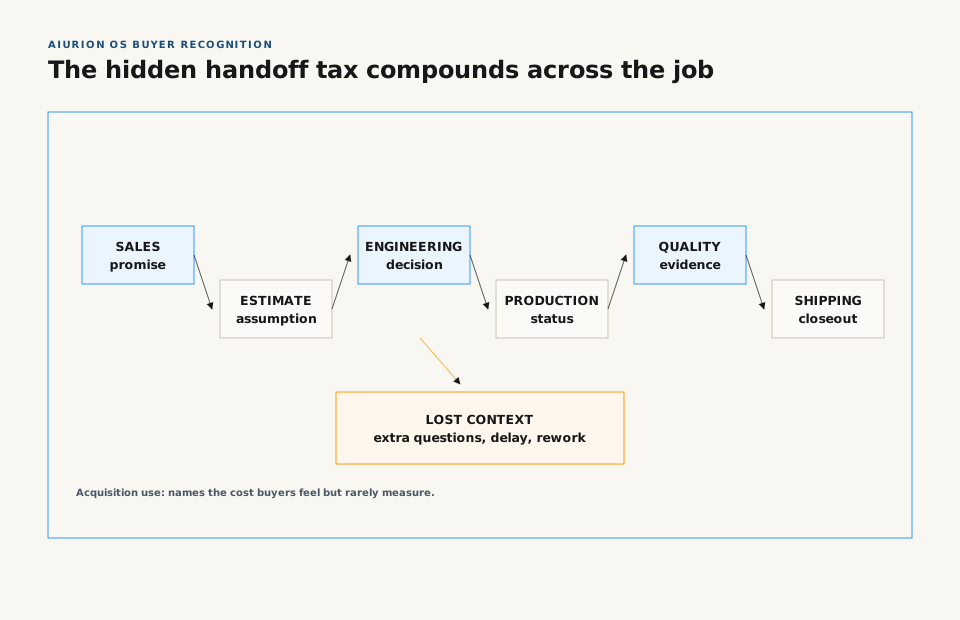
Diagram: Every handoff that loses context taxes margin, delivery, and trust.
Skip Ahead
- Where margin leaks
- The state-and-evidence chain
- The quote assumption problem
- The invoice readiness problem
- Where AIURION OS fits
- Your next move
Where Margin Leaks
A manufacturing quote is not only a price. It is a bundle of assumptions.
It may include:
- material grade and availability
- machine time
- setup time
- programming effort
- outside process cost
- inspection requirement
- fixture or tooling assumptions
- customer revision
- delivery promise
- exclusions or clarifications
If those assumptions stay trapped in the quoting tool, estimator notes, or email thread, the shop loses context the moment work becomes production.
That is where margin starts leaking.
| Handoff | What Gets Lost | What It Costs |
|---|---|---|
| RFQ to quote | customer nuance, revision risk | weak estimate |
| Quote to order | assumptions and exclusions | production surprise |
| Order to traveler | material and inspection context | rework and delay |
| Traveler to production | setup logic and constraint history | operator interruption |
| Production to QC | what must be proven | hold or escape risk |
| QC to invoice | completion evidence | delayed cash |
NIST's digital-thread work focuses on keeping product information usable across design, manufacturing, and quality instead of losing it at lifecycle boundaries [S1]. Quote-to-cash applies the same continuity test to the commercial job record.
The State-and-Evidence Chain
A status is useful only when the record contains the evidence needed to advance it.
| State | Evidence That Should Exist | Human Decision Before Advancing | Leakage When Missing |
|---|---|---|---|
| Quote approved | approved quote version, line items, notes, totals, approval/lifecycle event | confirm the accepted commercial basis | production inherits an untraceable price or assumption |
| Order created | order number, client, quantity, due/ship date, PO, linked quote context | confirm what accepted work is becoming production | scope is re-entered or silently changed |
| Traveler released | part/revision, quantity, material, routing, tooling, documents, QC plan, release timestamp | release the work packet to the floor | floor starts from incomplete instructions |
| Operations complete / QC ready | operation quantities, scrap, signoffs, inspection-required flags, QC plan/run state | confirm production evidence is complete enough for QC | "done" cannot be verified |
| QC complete | pass/open/hold/fail/N/A results, measurements, inspector, issue/action notes | disposition open, hold, or failed checks | packaging or shipment advances without evidence |
| Shipped / fulfilled | order shipment or fulfillment state, final quantity, required deliverables | confirm the physical and documentary shipment | invoice gets ahead of what was delivered |
| Invoice draft | linked customer/order, issue and due dates, line items, totals, notes | verify billed scope against shipped work | billing is delayed or reconstructed manually |
| Invoice sent | sent state and customer delivery action | confirm the invoice was actually issued | receivable aging starts from an ambiguous date |
| Invoice paid | paid state and paid date | record the received payment | cash reporting and follow-up drift |
These are operating controls, not a claim that every transition is automatic. In AIURION today, Quotes, Orders, Travelers, Production/QC, and Invoices each carry their own lifecycle actions; people approve, release, ship, send, and record payment.
The Quote Assumption Problem
Most shops can find the quote total. Fewer can find the reasoning behind it after the job is released.
That difference matters.
Hypothetical Leakage Path
This example is illustrative, not a customer result:
The estimator quoted a 20-piece aluminum housing assuming customer-supplied inserts, no cosmetic requirement on internal faces, and outside anodize with a known vendor. The job gets released two weeks later. The traveler says material and operations, but not the assumptions. Purchasing orders inserts because no one sees they were customer-supplied. The floor polishes surfaces that were not supposed to be cosmetic. The office later wonders why the job did not hit margin.
The quote was not only a number. It was operating context.
When the context gets dropped, production fills the gap with caution, memory, or interruption. None of those are free.
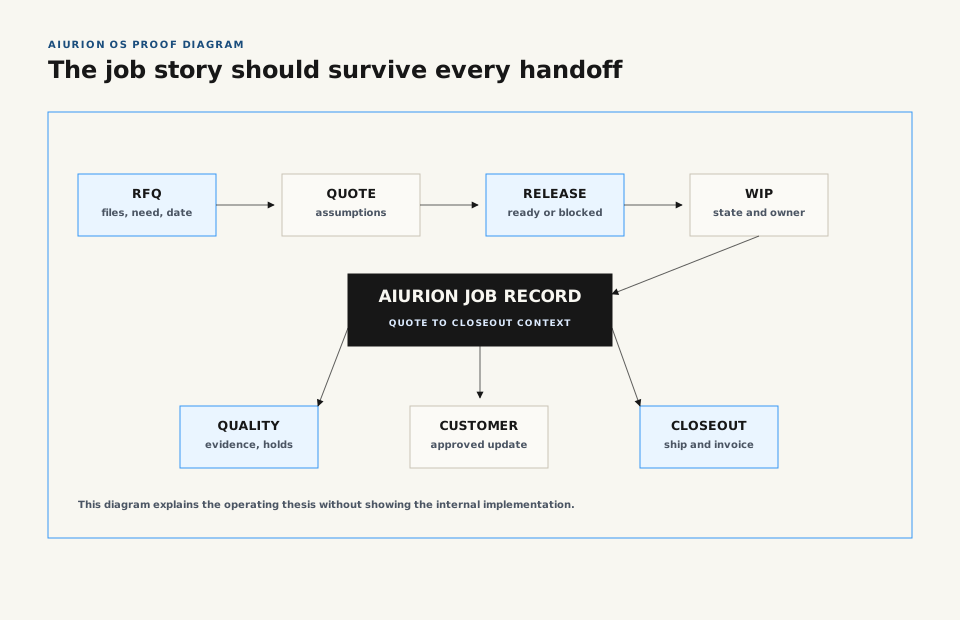
Diagram: The job story should survive every handoff.
The Invoice Readiness Problem
The other end of quote-to-cash has its own failure mode.
A job can be "done" and still not be ready to invoice.
The office may need:
- final quantity
- shipment confirmation
- customer PO reference
- partial shipment context
- outside process receipt
- QC signoff
- exception or rework record
- promised deliverables
- customer communication history
If invoice readiness depends on asking the floor what happened, cash conversion depends on memory.
This is why quote-to-cash needs the operating record, not just accounting software. ERP may record the invoice. It does not automatically prove that the job is commercially ready.
ISA-95 defines the interface between business and manufacturing functions and the information exchanged across it [S2]. The practical shop lesson is that the business handoff needs production evidence, and production needs quote context.
Where AIURION OS Fits
AIURION OS currently supports the main records in the chain: quote review/version history and conversion, order/traveler planning and release, Production/QC execution, shipment or fulfillment, and invoice draft/sent/paid states.
The workflow should carry:
- RFQ and customer files
- quote assumptions
- approved quote and due date
- traveler and release state
- production progress and blockers
- QC requirements and evidence
- shipment and invoice readiness
- permission boundaries
This does not mean every state propagates automatically or that AIURION replaces the accounting system. The value is that a reviewer can move through linked operational records instead of reconstructing the handoff from separate email threads.
The current assistant can summarize active work, production blockers, and available workspace context. It does not approve pricing, release travelers, mark work shipped, send invoices, or record payment; those remain human actions.
For quoting depth, see manufacturing quoting software. For the operating layer, see AIURION OS manufacturing operations. If quote-to-cash breaks between departments, request a focused pilot.
Your Next Move
Take one closed job that missed margin or invoiced late.
Walk backward:
- What delayed invoice readiness?
- What production evidence was missing?
- What QC or shipment context was unclear?
- What quote assumption was not visible?
- Where did the job record stop carrying the truth?
The answer is usually not "estimate better" or "invoice faster." It is "carry the job story better."