
Manufacturing Customer Status Updates: How to Answer From Evidence
The best customer status update is not a nicer sentence. It is a clearer answer from evidence the shop can verify.
TL;DR
Customer status updates should not require internal detective work.
If the shop has to ask three people before answering a customer, the problem is not communication style. The problem is the job record.
A good manufacturing status update should come from evidence: what was quoted, what is released, what operation is active, what is blocked, what QC has found, what the next verified step is, and whether the message is safe to send.
AIURION OS is useful here because it ties customer context, production state, blockers, QC, and permissions into one operating record. AI can help draft the update, but the truth has to come from the job.
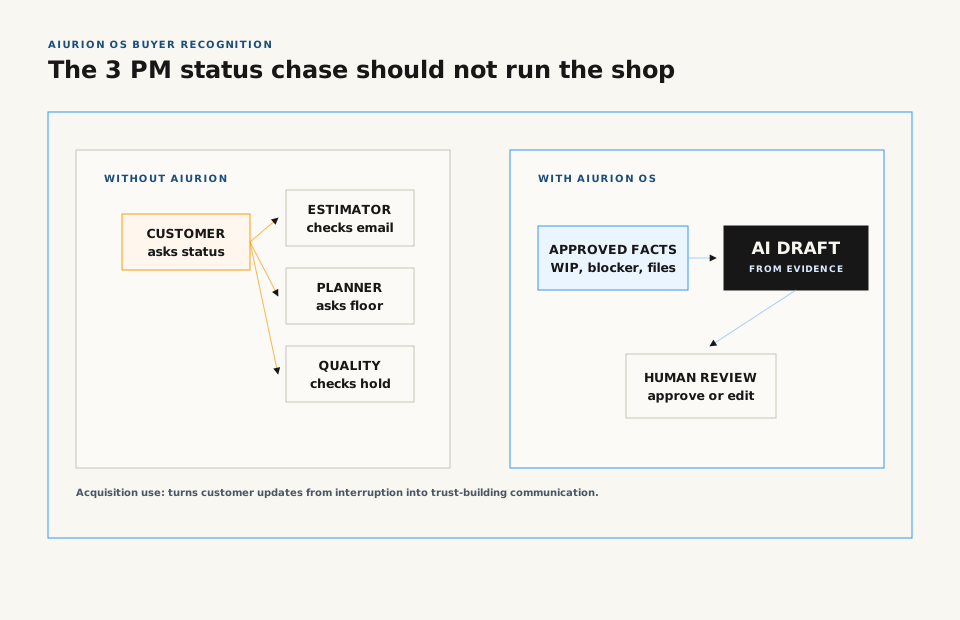
Diagram: The relatable customer-status fire drill becomes a facts-first update path.
Skip Ahead
- Why updates get vague
- The evidence-backed update
- From fact to approved message
- What AI can safely help with
- Where AIURION OS fits
- Your next move
Why Updates Get Vague
Most vague customer updates are not written by careless people.
They are written by people who do not have enough verified context.
Common examples:
- "The job is in production."
- "We are checking with the team."
- "It should ship soon."
- "We ran into a delay."
- "I will get back to you with an update."
Sometimes those are honest. But they are not useful if the customer needs to make a decision.
The shop may know more internally, but that knowledge is scattered:
- the estimator remembers the quote assumption
- the production lead knows the blocker
- purchasing knows the vendor status
- QC knows the inspection hold
- the office knows whether partial shipment is possible
If the customer update depends on stitching that together manually, every update becomes a small interruption chain.
The Evidence-Backed Update
A better customer update follows a simple structure:
- What is complete?
- What is currently blocking or active?
- What evidence supports that status?
- What is the next verified action?
- Does the customer need to do anything?
Example weak update:
We are still working on the order and expect to have more information soon.
Example evidence-backed update:
Machining is complete on the current revision. The job is waiting on outside anodize receipt before final inspection can close. The next verified step is vendor receipt, then final QC. We will update you after receipt is logged or sooner if the vendor date changes.
That update is better because it explains the job state without overpromising.
The real work is not the wording. The real work is having a job record that can support the wording.
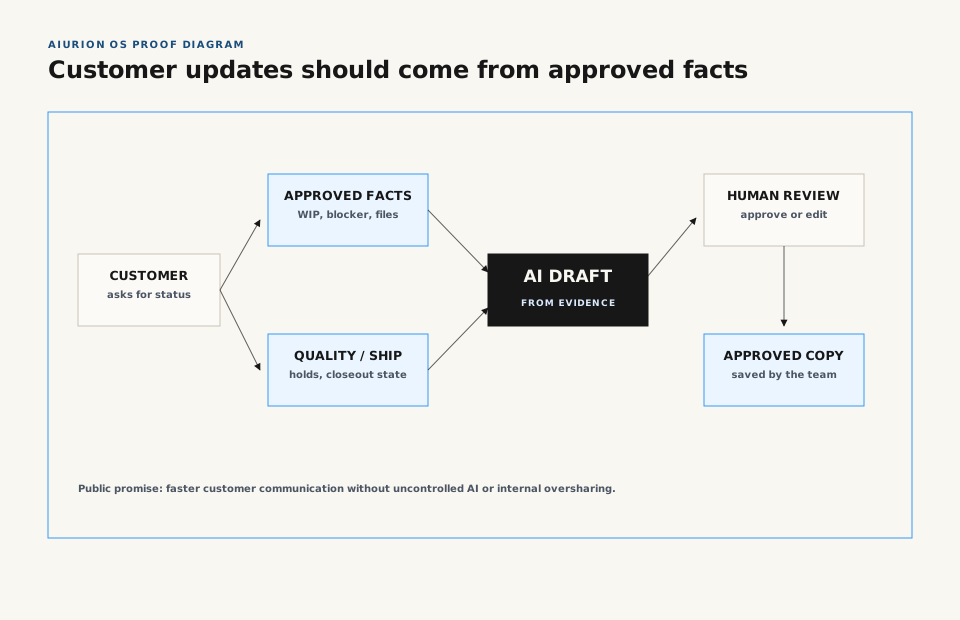
Diagram: Customer updates should come from approved facts.
From Fact To Approved Message
Do not draft from a general impression of the job. Build each customer-facing sentence from a record, then give the approver a specific check.
| Customer-facing sentence | Required record | Approver check | Where to preserve the sent message today |
|---|---|---|---|
| "Machining is complete on revision C." | traveler overview, revision, and completed operations | confirm accepted quantity and current revision | relevant order, traveler, or client note |
| "The job is waiting on outside anodize." | Production blocker plus vendor or PO note | confirm this is the active constraint | relevant order or traveler note |
| "The vendor expects return August 20." | dated vendor acknowledgment | label an estimate as an estimate; do not convert it into a promise | vendor or job note with the acknowledgment date |
| "Final inspection follows receipt." | traveler QC plan and current QC state | confirm no additional operation or open quality issue comes first | traveler note or approved customer message copy |
| "No action is required from you." | open-decision review | confirm there is no pending customer approval, deviation, or partial-shipment decision | sent message copy |
AIURION does not currently provide a complete, automatic customer-communication ledger tied to every job. The person who sends the update should preserve the approved version in the relevant record according to the shop's operating convention.
This article's standard is intentionally human-first: a defensible update needs a verified state, the current exception, the next action, and any decision required from the customer. The AI workflow comes after that standard, not before it.
What AI Can Safely Help With
Customer updates are a strong early AI use case because they are useful, bounded, and reviewable.
AI can help:
- summarize job state from the record
- identify the current blocker
- draft a customer-facing message
- remove internal jargon
- flag missing evidence before sending
- make the draft easier for a person to review
AI should not:
- invent a ship date
- hide QC uncertainty
- send without approval
- expose internal cost or margin context
- answer from stale files or unscoped folders
- ignore customer-specific permission boundaries
NIST's AI Risk Management Framework emphasizes trustworthiness considerations such as validity, reliability, accountability, privacy, and safety [S1]. In a manufacturing customer update, those ideas become practical: the assistant should be grounded, permissioned, reviewable, and tied to evidence.
The human approver still owns three decisions: whether the evidence is current, whether the language creates a commitment, and where the sent message is preserved.
Where AIURION OS Fits
AIURION OS makes customer updates easier by putting much of the evidence behind the message in the same workspace.
Current records can provide:
- customer and contact context
- quote and order context
- active job and traveler state
- blockers and owners
- QC state
- shipment and invoice readiness
- user permission scope
Outside-process detail may still be split across a vendor or purchase order, traveler notes, and a Production blocker. Sent customer messages also require deliberate preservation. Those are manual boundaries, not facts the assistant should paper over.
The current Assistant can draft customer updates from the current workspace snapshot and permissioned records. It does not send the message or make the customer commitment. A person inspects the evidence, edits and approves the draft, sends it through the shop's communication channel, and preserves the approved version.
The customer does not care what software category the shop bought. The customer cares whether the answer is clear, current, and safe to act on.
For the production state layer, see job shop production tracking. For permissioned AI, see AI for machine shops. If customer updates are consuming too much internal time, request a focused pilot.
Your Next Move
Review the last ten customer status questions.
For each one, ask:
- Who had to be interrupted?
- What record was missing?
- What answer did the customer actually need?
- Could the system have produced a reviewable draft from evidence?
If the same missing records repeat, customer communication is not the root problem. Operating visibility is.
References
[S1] NIST - AI Risk Management Framework [Link]