
Manufacturing Revision Control: Stop Letting File Changes Become Floor Risk
Revision control is not just document storage. It is how a shop keeps the right file tied to the right quote, traveler, operation, inspection, and customer promise.
TL;DR
Revision control fails when the shop can store files but cannot tell which file shaped the job.
The active revision should be connected to RFQ intake, quote assumptions, traveler release, production, QC, customer updates, and closeout. If it lives only in email or a folder name, the floor carries unnecessary risk.
AIURION records revision context in orders, travelers, files, quote versions, and job history. It does not currently auto-diff customer drawings or propagate a revision change through quotes, released travelers, routing, QC plans, and production. A responsible person still reviews the change and updates each affected record.
Skip Ahead
- Where revision risk appears
- The minimum control loop
- The customer-change test
- Revision change impact record
- Where AIURION OS fits
- Your next move
Where Revision Risk Appears
Revision risk shows up when:
- the quote used one file and production used another
- a customer email changed a note but not the job packet
- QC inspected against the wrong print
- a repeat job reused an old package
- a traveler was released before a file update
- a customer asked for status on work tied to an outdated revision
The danger is subtle. The job may appear controlled until someone asks which version was actually used.
ISO 10007 provides configuration-management guidance across the product or service lifecycle [S1]. SAE EIA-649C defines configuration-management functions and emphasizes a process scaled to product complexity, intended use, and lifecycle value [S2]. For a job shop, the practical unit of control is the revision impact record: what changed, what has already moved, and who approved the disposition.
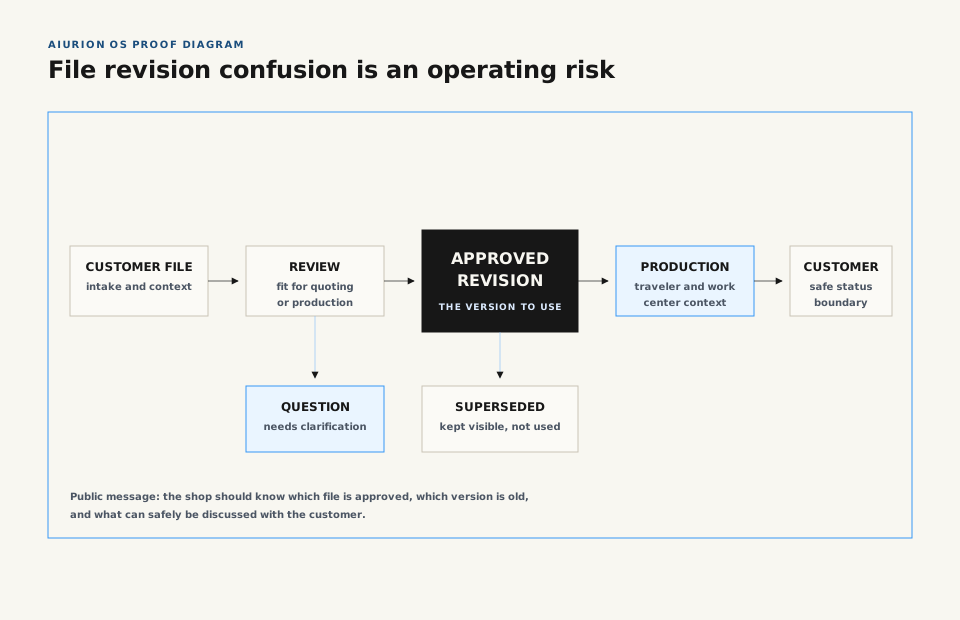
Diagram: The shop should know which file is approved and which version is old.
The Minimum Control Loop
A revision control loop should capture:
| Step | Control Question |
|---|---|
| Intake | Which file and revision did the customer provide? |
| Quote | Which revision shaped the estimate? |
| Release | Which revision is approved for the traveler? |
| Production | Which revision is active at the operation? |
| QC | Which revision shaped inspection? |
| Closeout | Which revision was delivered and invoiced? |
If the shop cannot answer those questions from the job record, revision control is incomplete.
The Customer-Change Test
When a customer sends a changed print, the system should show:
- what changed
- who reviewed it
- whether quote assumptions changed
- whether the traveler needs revision
- whether work already started
- whether QC needs updated requirements
- whether the customer update changes
If the system cannot show the impact, the shop will process the change through conversation.
Revision Change Impact Record
Create one record before replacing the active file. Keep it with the job history.
| Field | Required Entry |
|---|---|
| Job / customer | Order number, part, customer |
| Old revision / new revision | Exact identifiers from the controlled source |
| Received | Timestamp and channel/source |
| Files affected | Drawing, model, PO, specification, program, inspection plan |
| Reviewer | Person accountable for impact review |
| Quoted basis | Revision and quote version used for price and delivery |
| Work state | Not started, material committed, setup started, operations completed, shipped |
| Traveler impact | Routing, program, fixture, setup note, or document changes required |
| QC impact | Characteristics, method, sampling/FAI, cert, or completed evidence affected |
| Commercial impact | Requote, lead-time change, scrap/rework, expedite, no impact |
| Customer decision | Written approval, clarification, deviation, cancellation, or pending |
| Disposition | Hold, continue unaffected work, rework, scrap, restart, or close with no impact |
| Approvals and timestamp | Engineering/quality/operations/customer as required |
Illustrative Completed Record
| Field | Example Entry |
|---|---|
| Job / customer | J-2426 / actuator bracket / Atlas Motion |
| Change | Drawing Rev B to Rev C, received Aug 4 at 10:18 AM through customer email |
| Reviewer | A. Patel, quality manager |
| Quoted basis | Quote Q-1187 version 2 used Rev B |
| Work state | Material committed; operation 10 complete on 8 of 20 pieces |
| Traveler / QC impact | Operation 30 profile changed; CAM and critical-dimension check require review |
| Commercial impact | Rework feasibility and delivery effect pending; do not reuse the old price |
| Customer decision | Written direction requested; production held at operation 20 |
| Disposition | Continue no affected work; update records only after approval |
The names and numbers are fictional. The useful feature is the chain from received change to work state, impact, decision, and approval.
Where AIURION OS Fits
AIURION OS can preserve part revision, quote version and lifecycle context, traveler documents, QC evidence, and change history around the operating job.
That record lets the human reviewer determine whether the change affects:
- quote context
- traveler readiness
- production blockers
- QC requirements
- customer communication
- invoice and delivery history
Current boundary: AIURION does not automatically compare old and new engineering files, rewrite a released traveler, update the QC plan, reprice the quote, or propagate a revision to every downstream record. Structural traveler planning belongs in draft, and release cannot be undone from the traveler modal. The responsible team must review, approve, and apply the impact record.
For quote context, see manufacturing quoting software. For traveler context, see paperless shop travelers. If revisions are creating floor risk, request a focused pilot.
Your Next Move
Find one repeat job and trace which revision was quoted, released, inspected, and shipped. If the answer requires email archaeology, revision control needs attention.