
AI Quoting Assistant for Manufacturing: Useful Review, Not Magic Pricing
AI can support manufacturing quoting when it works from the RFQ package, quote history, assumptions, and permissioned job context.
TL;DR
An AI quoting assistant should not be sold as magic pricing.
The useful version reviews the context it can actually access, identifies missing information, drafts customer clarification questions, and prepares a traceable review memo for the estimator.
The unsafe version invents pricing from incomplete context.
AIURION today provides quote creation, review/approval, version history, conversion, analysis-to-quote handoff, and a workspace-aware assistant. It does not yet prove dedicated similar-job retrieval, automatic assumption extraction, or automatic pricing. Humans approve the commercial decision.
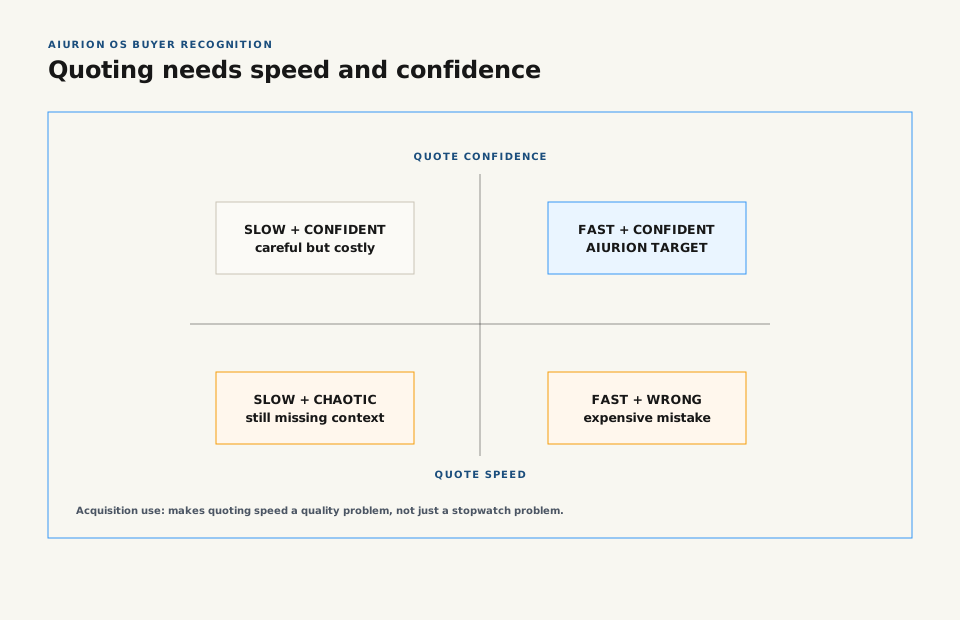
Diagram: The goal is not just faster quoting; it is faster quoting with preserved assumptions.
Skip Ahead
- What AI can help with
- What AI should not decide
- Buyer standard for AI-assisted quote review
- The estimator review loop
- Sample quote-review memo
- What AIURION supports today
- Your next move
What AI Can Help With
AI can help review the inputs placed in its permitted context:
- summarize the RFQ package
- list missing files or requirements visible in that package
- identify stated material, quantity, revision, inspection, delivery, and outside-process mentions
- draft clarification questions
- separate confirmed facts from proposed assumptions
- prepare a review memo with source references
This is useful only when the reviewer can see what the assistant used. If similar-job history, customer email, a current material rate, or a machine rate is not in the permitted context, the assistant should say so rather than imply retrieval.
NIST's AI Risk Management Framework is designed to help organizations manage AI risk and incorporate trustworthiness into AI design, deployment, use, and evaluation [S1]. In quoting, that means buyers should demand provenance, uncertainty, human accountability, and a testable boundary.
What AI Should Not Decide
Do not start with AI auto-pricing complex work.
Avoid:
- final price approval
- margin decisions
- lead-time commitments
- customer promises
- production release
- substitute material decisions
- ignored missing requirements
AI can prepare the review. The estimator owns the decision.
Buyer Standard for AI-Assisted Quote Review
Evaluate the workflow against evidence, not a demo prompt.
| Buyer Requirement | Evidence to Demand | Fail Condition |
|---|---|---|
| Source provenance | Every extracted fact points to a file, field, report, or user-supplied note | The memo states requirements without showing their source |
| Missing-input behavior | The assistant labels absent or conflicting revision, material, quantity, inspection, finish, and delivery inputs | It fills gaps with plausible defaults |
| Pricing boundary | Rates, setup, material, margin, and commercial assumptions show their human or system source | A confident price appears without approved inputs |
| Retrieval boundary | Similar-job claims identify the retrieved jobs and matching criteria | "Based on similar jobs" appears without records |
| Permission boundary | The assistant only uses records the current user may access | Hidden customer or job context appears in the answer |
| Human approval | A named estimator reviews price, lead time, exclusions, and customer commitments | AI output can become a final quote without approval |
| Handoff durability | Approved assumptions are saved in quote notes/version context and carried deliberately into production | The review disappears after quote approval |
| Evaluation record | The team logs misses, corrections, and accepted outputs on representative RFQs | Success is measured only by speed or a polished demo |
The standard is intentionally stricter than "did it produce a reasonable number?" A reasonable number with unknown inputs is not a controlled quote.
The Estimator Review Loop
A practical assistant workflow:
- Put the current RFQ files, linked analysis, and approved shop inputs in the review context.
- Ask for confirmed facts, conflicts, and missing information—not a final price.
- Require source references for every extracted requirement.
- Let the assistant draft clarification questions and proposed assumptions.
- Have the estimator supply or approve rates, setup, margin, lead time, and exclusions.
- Save the approved quote version and notes.
- Carry those approved assumptions deliberately into the order and traveler.
The last step matters. A good quote is not enough if the assumptions disappear after the win.
Sample Quote-Review Memo
This fictional memo demonstrates the expected boundary; it is not AIURION output from a customer RFQ.
Review scope
- Drawing:
AM-4421revC.pdf, Rev C - Model:
AM-4421revC.step - Requested quantity: 20
- Requested delivery: Aug 28
Confirmed from supplied files
- Material note calls for 6061-T6 aluminum.
- Drawing calls for clear anodize after machining.
- Two dimensions are marked for inspection reporting.
Missing or conflicting
- Customer PO is not attached.
- Drawing does not state whether material certification is required.
- RFQ email says "cosmetic" but does not define applicable surfaces or acceptance.
- No approved outside-process quote is present.
Questions to send
- Is a material certificate required with delivery?
- Which surfaces are cosmetic, and what acceptance standard applies?
- Is a dimensional report required for all pieces or a customer-approved sample?
Estimator decisions required
- Select process route and setup plan.
- Obtain or approve material and anodize inputs.
- Set machine rates, margin, lead time, exclusions, and final price.
Explicit boundary
- No similar-job search was performed.
- No automatic price or delivery commitment was generated.
What AIURION Supports Today
AIURION Quotes can create priced proposals, carry line items and notes, move through review and approval, retain version history, clone an existing quote, and convert accepted work into orders or production. Reports can turn a saved part analysis into a quote. The Assistant can use the current workspace snapshot and selected records when that context is available.
Those capabilities support a review workflow, but they do not establish dedicated similar-job retrieval, automatic assumption extraction from every RFQ document, or automatic pricing. Cloning a quote is not semantic similar-job retrieval. Analysis and stored shop rates are not permission to skip estimator review. The estimator remains responsible for price, margin, lead time, exclusions, and the customer commitment.
For the broader AI view, read AI for machine shops. For quoting workflow, see manufacturing quoting software. If AI quoting is interesting but your RFQ records are scattered, request a focused pilot.
Your Next Move
Pick one representative quote and run the buyer-standard table against it. Reject any output that cannot distinguish sourced facts, missing inputs, proposed assumptions, and estimator decisions.
References
[S1] NIST - Artificial Intelligence Risk Management Framework (AI RMF 1.0) [Link]