
Shop Floor Visibility Without Dashboard Theater
Real shop floor visibility lets a responsible person verify job state, understand the exception, and take the next action without calling a status meeting.
TL;DR
A dashboard is not shop floor visibility merely because it refreshes.
Useful visibility lets a responsible person answer five things from the job record: what state is true, what evidence supports it, what exception threatens the promise, who owns the next action, and which downstream handoff is blocked.
The test is operational: can the viewer make a safe decision without asking the floor to reconstruct the story? If not, the screen is display—not visibility.
AIURION's current Production matrix is built around released traveler work, phase gates, requirement status, blockers, owners, due dates, and next actions. The Traveler remains the detailed execution and evidence surface. That separation is more important than adding another chart.
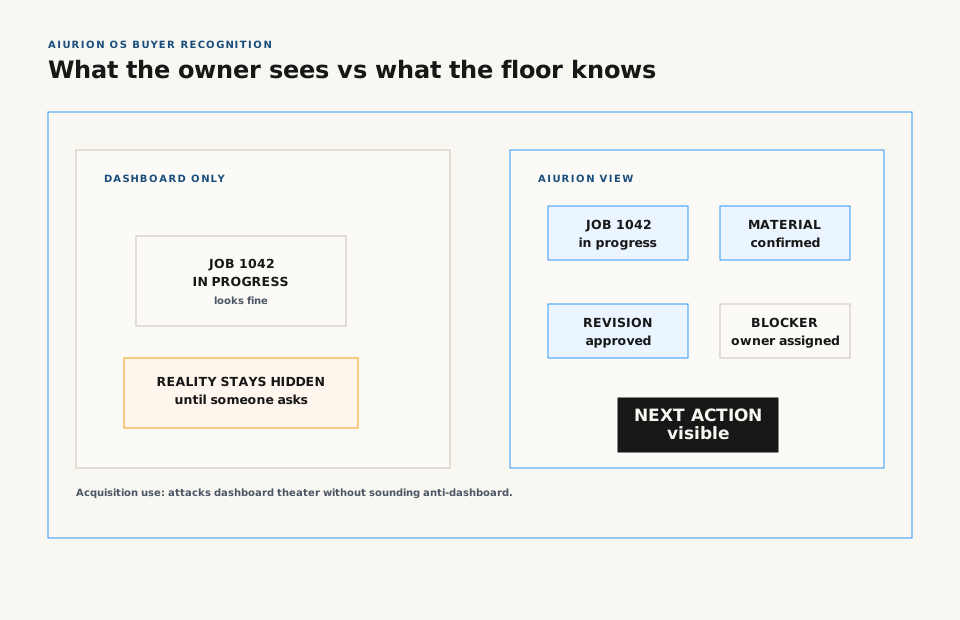
Diagram: A status label becomes useful when the reason, evidence, owner, and next decision travel with it.
Skip Ahead
- The dashboard trap
- Copy the decision-grade job card
- A filled visibility example
- Audit the dashboard you already have
- Where AIURION fits today
The Dashboard Trap
Dashboard theater has recognizable symptoms:
- red, yellow, and green states have no shared definition;
- the status cannot be traced to an operation or evidence record;
- “late” is shown without the constraint causing it;
- every exception has the same urgency;
- ownership means a department, not a person or role;
- the next action lives in a meeting note;
- production complete, QC complete, ready to ship, and ready to invoice collapse into one “done” state;
- stale updates remain indistinguishable from live ones.
The screen may be visually accurate and operationally useless.
NIST's trustworthy smart-manufacturing program explicitly treats performance, reliability, security, and confidence in manufacturing systems and data as dimensions that require measurement, standards, and test methods [S1]. A trustworthy status therefore needs more than a color: it needs a definition, provenance, and current evidence.
This is why visibility depends on a manufacturing source of truth and a controlled system of action. The record explains the state; the action layer gives it an owner and a next move.
Copy the Decision-Grade Job Card
Every exception view should be able to produce this compact card.
| Field | Required answer |
|---|---|
| Job and promise | Order/part, customer, quantity, revision, committed date |
| Current executable state | Released traveler, active operation, completed quantity, current phase |
| Evidence | Operation event, requirement row, QC result, document, or history entry supporting the state |
| Exception | Specific blocker, failed gate, late dependency, or missing decision |
| Promise impact | What date, quantity, quality gate, shipment, or invoice is exposed? |
| Owner | Named person or role authorized to take the next step |
| Next action | One observable action, not “monitor” or “follow up” |
| Action due | When must that action happen? |
| Next review trigger | Event or time that causes the state to be re-evaluated |
| Downstream handoff | Which next phase or business action is waiting? |
| Safe customer statement | Evidence-backed wording the account owner may review |
If the dashboard cannot assemble those fields, it should link directly to the record that can. Do not duplicate evidence into a summary and let the duplicate become a second truth.
A Filled Visibility Example
This example is illustrative, not a claimed AIURION customer result.
The dashboard says job J-1042 is late. The decision-grade card says:
| Field | Filled example |
|---|---|
| Job and promise | J-1042, 24 Rev D housings, customer ship date Friday |
| Current executable state | Machining complete; final inspection not started |
| Evidence | Op 20 completion recorded Wednesday; traveler history shows quantity 24 accepted |
| Exception | Outside anodize lot has not returned |
| Promise impact | Final inspection, packaging, shipment, and invoice remain blocked |
| Owner | Purchasing lead |
| Next action | Obtain vendor completion and courier confirmation |
| Action due | Thursday 10:00 AM |
| Next review trigger | Vendor confirmation or 10:00 AM escalation time |
| Downstream handoff | Quality receives the lot for final dimensional/finish checks |
| Safe customer statement | Machining is complete; outside finishing is the current constraint; revised shipment status will be confirmed Thursday morning |
Now leadership can make a decision:
- escalate the vendor;
- arrange pickup;
- review whether partial shipment is possible;
- notify the customer with bounded language;
- protect inspection capacity for the returning lot.
“Late” could not support any of those actions by itself.
What Visibility Must Not Collapse
Status and evidence
“Operation complete” is a status. Accepted quantity, operator, completion time, and signoff are evidence.
Blocker and owner
“Waiting material” describes a condition. A requirement row with supplier note, ETA, responsible buyer, and next follow-up creates ownership.
Production completion and business completion
The final machine operation can be done while QC, documentation, packaging, shipment, and invoicing remain open.
Current state and history
The current status tells the team where the job stands. History explains how it got there and whether a correction, reassignment, or change was authorized.
Recommendation and commitment
Software may surface a next action or draft a customer message. An authorized person still owns schedule, quality, release, and customer commitments.
Audit the Dashboard You Already Have
Select every red or yellow job shown today and complete this worksheet.
| Audit question | Yes / No | Where verified | Gap owner |
|---|---|---|---|
| Is the status definition explicit? | |||
| Is the underlying evidence one click away? | |||
| Is the specific blocker visible? | |||
| Is one next action named? | |||
| Does that action have an owner and due point? | |||
| Is promise impact visible? | |||
| Are production, QC, shipping, and invoice states distinct? | |||
| Can the viewer see when the record last changed? | |||
| Does the state change write back to job history? |
Classify the gap:
- Definition gap: people disagree on what the status means.
- Evidence gap: the claim cannot be verified from the job.
- Ownership gap: the exception has no authorized next actor.
- Workflow gap: action occurs elsewhere and does not write back.
- Freshness gap: the screen cannot distinguish current from stale state.
- Handoff gap: the dashboard ends at production and hides quality or commercial closeout.
Fix the most common gap before adding another visualization.
What to Measure Instead of Dashboard Engagement
Do not judge visibility software by logins or screen views alone. Measure whether it shortens or removes reconstruction work.
Useful measures include:
- time from blocker creation to owner assignment;
- percentage of blocked jobs with one named next action;
- time from operation event to current-state update;
- status questions answered from the record without a meeting;
- customer updates sent with cited job evidence;
- jobs marked production-complete while QC, shipping, or invoicing still lacks an owner;
- corrections that preserve actor, reason, and history.
Set targets from the shop's baseline. There is no responsible universal “good dashboard” threshold.
The job readiness KPI addresses missing inputs before release. Shop-floor visibility begins once the job is active and exceptions need decisions. Keeping those boundaries separate prevents a dashboard from hiding poor release quality.
Where AIURION Fits Today
AIURION's current Production surface provides:
- released traveler jobs with customer, part, quantity, revision, and order context;
- due-state views for due today, late, this week, or future;
- top-level counts for Active Jobs, Due Today, Late, Blocked, and In Ops;
- filters including Waiting Material, Waiting Tooling, Waiting Programming, Needs QC, and Ready to Ship;
- Material, Tooling, Programming, Setup, Operations, QC, and Packaging phase state;
- requirement-level status, owner, notes, and ETA for material and tooling;
- operation owner and progress from the released traveler;
- gated progression and a computed next-action cue.
The boundary is equally important:
- Production is the supervisor and dispatch summary.
- Traveler is the detailed work packet for execution, QC results, documents, corrections, quantities, scrap, and history.
- Scheduling turns open released operations into a day plan.
- Assistant can discuss blockers, due dates, owners, QC readiness, and next actions from available context, but a person remains responsible for commitments and corrections.
That is decision-oriented visibility without claiming the summary replaces the underlying evidence.
For the public production-tracking view, see AIURION job shop production tracking.
Recommended Next Move
Complete the dashboard audit for today's red and yellow jobs. Choose the most frequent missing field—evidence, blocker, owner, next action, or handoff—and fix that operating record before redesigning the screen.
If the gap spans Production and Traveler state, request a focused AIURION shop-floor visibility pilot around that decision path.
References
[S1] NIST - Trustworthy Systems, Components, and Data for Smart Manufacturing Program [Link]