
System of Record vs System of Action in Manufacturing
A system of record preserves approved facts. A system of action turns those facts into an owned next step and writes the result back.
TL;DR
A manufacturing system of record preserves approved facts and transactions. A system of action uses those facts to coordinate an owned decision: release, hold, buy, assign, inspect, update, ship, invoice, or escalate.
The distinction is not “old software versus AI.” A reliable action layer needs four controls: a trusted trigger, the evidence behind the recommendation, an authorized owner, and a writeback that updates the record. Without those controls, workflow automation creates faster side effects, not better operations.
AIURION currently spans both roles in specific areas. Quotes, Orders, Travelers, and Invoices preserve lifecycle records; Production applies readiness gates, blockers, owners, and next-action cues to released traveler work. It complements stable business records rather than requiring a shop to discard them.
Skip Ahead
- Draw the boundary correctly
- The closed-loop action test
- Copy the action-design canvas
- A filled action example
- Where AIURION fits today
Draw the Boundary Correctly
A system of record answers questions such as:
- Which quote version was approved?
- What order and customer PO exist?
- Which traveler revision was released?
- What quantity completed and what scrap was recorded?
- What inspection result and invoice state are on file?
A system of action answers a different set:
- What is missing before release?
- Which material requirement blocks setup?
- Who owns vendor follow-up?
- What operation should run next?
- What evidence is required before QC or shipment?
- What customer update is safe to send?
Both are necessary. Neither should impersonate the other.
ISA-95 defines models and information exchange across enterprise and manufacturing operations functions [S1]. That boundary is useful here: an ERP can remain authoritative for commercial transactions while an operations layer coordinates live work and returns outcomes to the relevant record.
The category mistake is expecting a ledger to behave like dispatch—or allowing a dispatch tool to create commercial truth without controlled writeback.
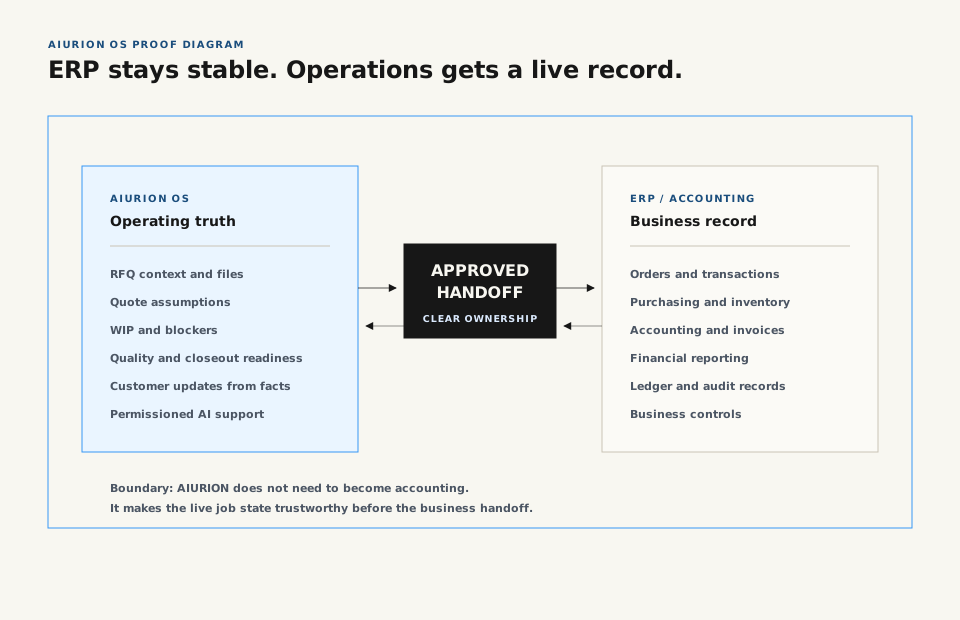
Diagram: Stable commercial records and live operations can have different responsibilities while remaining connected.
For the authority question, see the manufacturing source-of-truth audit. For remediation of bad records, use the job-first manufacturing data cleanup worksheet. This article addresses the next layer: turning a reliable state into controlled action.
The Closed-Loop Action Test
A useful system of action completes a loop:
- Trigger: A material event occurs—new order, missing requirement, late date, blocked operation, failed check, or completed phase.
- Context: The system assembles the current job, customer, requirement, owner, permission, and evidence.
- Decision rule: A documented rule or authorized person determines what should happen.
- Action: The system assigns, routes, drafts, blocks, advances, or requests approval.
- Writeback: The resulting state, actor, time, and reason are recorded.
- Escalation: If the rule cannot resolve the case, the right person receives the exception.
If any step is missing, the action layer leaks:
- no trigger means people keep polling dashboards;
- no context means the recommendation is generic;
- no authority means automation bypasses governance;
- no writeback means the record and reality split;
- no escalation means exceptions disappear into queues.
Copy the Action-Design Canvas
Use one canvas per decision. Do not begin with “automate production.”
| Field | Definition | Your workflow |
|---|---|---|
| Decision | The exact action the workflow should support | |
| Trigger | The event or state that starts evaluation | |
| Required evidence | Records that must be current before action | |
| Rule or policy | What makes the action valid | |
| Authorized actor | Person or role allowed to commit | |
| System assistance | Summarize, flag, draft, route, block, or execute | |
| Writeback | Record and fields changed after approval/action | |
| Exception | Conditions that stop automation and require review | |
| Success measure | Observable operating outcome |
Keep “system assistance” specific. “Use AI” is not a workflow definition. “Draft a customer update from the current blocker and due date for account-owner review” is.
A Filled Action Example
This example is illustrative, not a claimed customer result.
A released job cannot advance because one material requirement is blocked.
| Field | Filled example |
|---|---|
| Decision | Escalate material follow-up and prevent setup from starting |
| Trigger | Material requirement changes to Blocked or misses its follow-up date |
| Required evidence | Order, traveler, requirement label, supplier note, owner, ETA, due date |
| Rule or policy | Setup cannot become ready while an active material row is blocked |
| Authorized actor | Purchasing updates supplier status; production manager may approve a disposition |
| System assistance | Flag the job, name the owner, show the next action, draft internal/customer wording |
| Writeback | Requirement status, note, ETA, actor, timestamp, and any approved disposition |
| Exception | Substitution, partial release, or customer date change requires human approval |
| Success measure | No setup starts against a known blocked material requirement |
The action is not “send more alerts.” It is a controlled state transition with an owner and evidence.
What Belongs in Each Layer
| Capability | Record layer | Action layer |
|---|---|---|
| Quote | Approved version, line items, totals, notes, lifecycle | Review queue, missing-input flag, approval routing |
| Order | Customer job, quantity, due date, status | Start-production decision, readiness exception, owner follow-up |
| Traveler | Released routing, requirements, QC plan, history | Assignment, operation execution, correction workflow |
| Production | Phase and requirement state | Gate enforcement, blocker ownership, next-action cue |
| Quality | Plan, measurement, result, disposition | Hold, review, corrective action, release decision |
| Customer communication | Approved communication history | Evidence-backed draft and human approval |
| Invoice | Billing record and revision state | Readiness check, approval, send/void workflow |
This is not a universal software map. It is a responsibility check. A shop may place functions in different applications, provided authority and writeback remain clear.
Buyer Questions That Expose the Difference
When evaluating a workflow or manufacturing operations product, ask the vendor to demonstrate one job end to end:
- Which record is authoritative before the action?
- What event triggers the workflow?
- Which evidence is visible at the decision point?
- What is automated, drafted, blocked, or merely suggested?
- Which person or role is allowed to commit?
- Where is the result written back?
- Can we see the actor, time, and reason?
- What happens when records conflict or information is missing?
- Can the workflow operate without replacing our accounting system?
A polished dashboard is not an answer. Ask to see the state change and its history.
Where AIURION Fits Today
AIURION's implemented product surface provides a concrete record/action split:
- Quotes records priced proposals, review states, versions, notes, client communication, and conversion history.
- Orders records customer jobs and connects them to traveler and invoice workflows.
- Travelers preserve the released work packet and record assignments, execution, quantity, scrap, QC, corrections, and history.
- Production turns released traveler data into phase health, requirement gates, blockers, owners, and a next-action cue.
- Scheduling converts open released operations into a day plan.
- Assistant can discuss blockers, owners, due dates, current operations, QC readiness, and next actions from available permissioned context.
The boundary matters: the Assistant can summarize and draft; customer commitments, traveler release, corrections, and commercial decisions remain in human-controlled workflows. That aligns with the NIST AI RMF's emphasis on managing trustworthiness and risk throughout AI use [S2].
AIURION is therefore not “an autonomous layer that runs the shop.” It is an operating layer that can connect records to governed action in the workflows the product currently supports.
For a comparison with the stable business layer, see when a machine-shop ERP is enough.
Recommended Next Move
Fill the action-design canvas for one recurring decision that currently requires a status meeting. Require a trigger, evidence, authorized actor, and writeback before selecting automation.
If that loop crosses Quotes, Orders, Travelers, or Production, request a focused AIURION system-of-action pilot around that one decision.