
AI Customer Update Assistant: Draft From the Job Record, Not Guesswork
AI can draft better customer updates when the job record contains the truth. Without that record, it only writes smoother uncertainty.
TL;DR
Customer updates can be a bounded early AI workflow in manufacturing because a person can inspect the evidence and approve the language before anything leaves the shop.
The current AIURION Assistant can draft a clear message from the current workspace snapshot and permissioned records. A person still verifies the job state, edits and approves the draft, sends it through the shop's communication channel, and preserves the approved message.
The assistant is a drafting surface, not the authority for dates, quality disposition, or customer commitments.
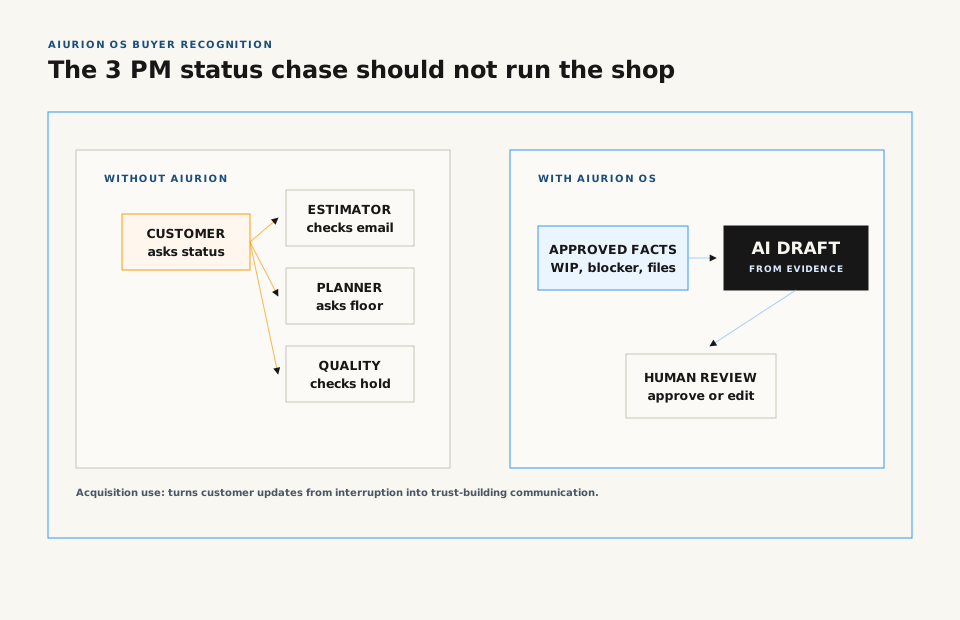
Diagram: The relatable customer-status fire drill becomes a facts-first update path.
Skip Ahead
- What the assistant needs
- The review rule
- The current AIURION workflow
- A better draft
- Where AIURION OS fits
- Your next move
What The Assistant Needs
The assistant needs:
- customer context
- quote or order context
- active traveler state
- current operation
- blocker owner
- outside process status, when the shop has recorded it
- QC status
- next verified step
- permission scope
NIST's AI Risk Management Framework is intended to help organizations incorporate trustworthiness into the design, use, and evaluation of AI systems [S1]. In customer communication, that becomes a practical review rule: the draft should identify the job evidence it used and expose missing context.
The Review Rule
AI can prepare the update. A person verifies, approves, sends, and preserves the update.
Do not allow AI to:
- invent dates
- hide quality uncertainty
- expose internal notes
- send without review
- mention cost or margin
- answer from stale files
This keeps the workflow useful without making AI the authority. Approval is not a quick grammar check; it is confirmation that the status is current and the language does not create an unsupported promise.
The Current AIURION Workflow
Use the Assistant as a five-step reviewable workflow:
| Step | Operator action | Product boundary |
|---|---|---|
| 1. Select context | open the relevant order, traveler, or Production view; confirm the Assistant shows context ready | selected-record context is available only when the platform provides it |
| 2. Request a draft | ask for a customer update for the named job and require current status, blocker, and next action | the Assistant drafts from the current workspace snapshot and permissioned records |
| 3. Inspect evidence | compare every sentence with the traveler, Production state, QC run, and any manual vendor note | the Assistant may not have a complete outside-process or communication record |
| 4. Edit and approve | remove internal detail, label estimates, and have the responsible person approve commitments | AI does not own the ship date, quality disposition, or release decision |
| 5. Send and preserve | send through the shop's approved email or customer channel, then save the approved message in the relevant operating record | AIURION does not automatically send the message or maintain a complete job-level communication ledger |
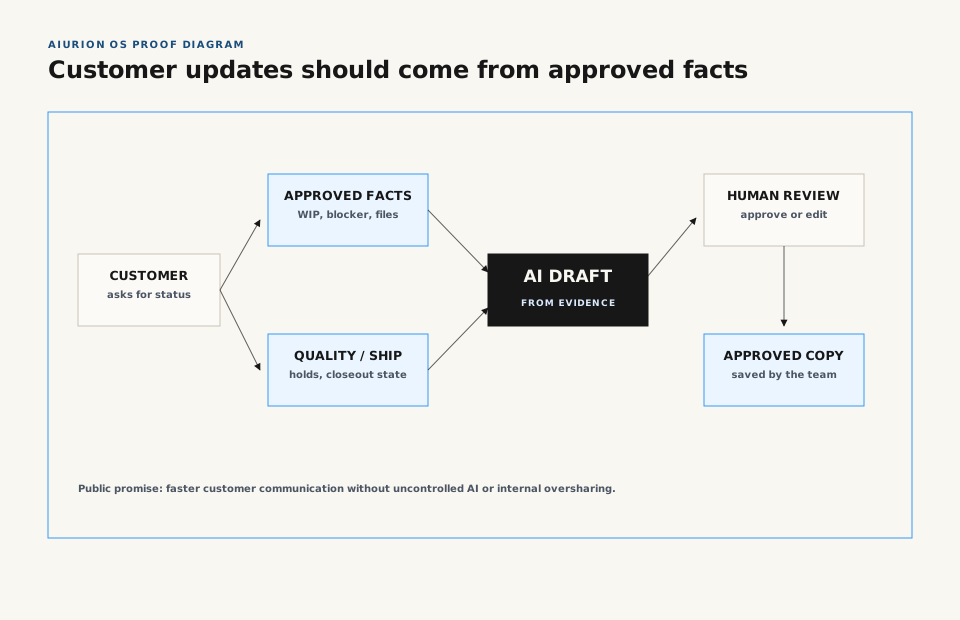
Diagram: The draft is useful only when each customer-facing claim can be traced to approved evidence.
A Better Draft
Weak draft:
We are still working on the parts and expect an update soon.
Evidence-backed draft:
Machining is complete. The job is waiting on outside coating receipt before final inspection can close. The next verified step is receipt, then QC signoff. We will update you when receipt is logged or if the vendor date changes.
The second draft is better because it separates completed work, the current constraint, and the next verified step. Before sending, the reviewer still needs to confirm that the coating status and vendor date are current.
Where AIURION OS Fits
The current Assistant receives a platform snapshot that can include the current view and selected records. From Production, that context can include jobs, due dates, blockers, phase readiness, assignments, and next actions.
That gives the draft useful operating evidence:
- real status
- current blocker and owner
- QC evidence
- customer context
- permissioned records
It does not make every fact complete. Outside-process detail may still live across a vendor or purchase-order record, traveler notes, and a Production blocker. The Assistant conversation is also not a substitute for preserving the final sent message in the shop's chosen record.
For the human communication standard, see manufacturing customer status updates. For the broader AI boundary, see AI for machine shops. If customer updates are a daily interruption, request a focused pilot using one real job and one accountable approver.
Your Next Move
Take one status email you sent recently. Mark each sentence as verified record, human confirmation, estimate, or commitment. Then run the five-step workflow on the same job and compare the result. Any sentence with no evidence is a record problem, not a prompt problem.
References
[S1] NIST - AI Risk Management Framework [Link]