
ERP vs MES vs QMS: Where a Manufacturing OS Fits
ERP, MES, and QMS solve different manufacturing problems. The real buying question is which system owns each decision and whether the job survives the handoffs between them.
TL;DR
ERP, MES, and QMS are not interchangeable.
ERP typically owns business planning and transactions. MES typically owns production execution. QMS governs the processes and evidence used to control quality. A manufacturing operating layer is useful only when the shop still cannot follow one job across those boundaries without reconstructing the story from several systems and several people.
That does not make a manufacturing OS a standardized fourth category or an automatic replacement for the other three. It is a practical description of the cross-system job record: what the customer requested, what the shop quoted, what was released, what is running, what is blocked, what quality found, and what is ready to ship or invoice.
The buying decision should begin with responsibility. Decide which system must remain authoritative for finance, execution, and quality. Then inspect the handoffs. If your existing stack already makes the live job readable, you may not need another layer.
Skip Ahead
- Start with responsibility
- Follow one job across the boundaries
- Use the decision guide
- When another operating layer is unnecessary
- Questions to resolve before buying
- Where AIURION OS fits
Start With Responsibility, Not A Replacement Story
Software comparisons become misleading when every product is presented as though it should run the whole company.
ISA-95 gives manufacturers a more useful boundary. It places ERP-style business planning and logistics at level 4 and manufacturing operations management, including MES, at level 3 [S1]. A QMS cuts across the organization differently: it defines the processes, responsibilities, documented information, measurement, and improvement needed to meet customer and regulatory requirements [S2].
Use this responsibility map before comparing feature lists:
| System | Primary Responsibility | Strongest When The Shop Needs | It Should Not Be Assumed To Own |
|---|---|---|---|
| ERP | business planning and commercial transactions | purchasing, inventory, costing, orders, accounting, MRP, and financial control | detailed live execution or every quality workflow |
| MES | manufacturing execution | dispatch, operation progress, labor or machine capture, WIP, and production performance | financial accounting or the full quality-management system |
| QMS | quality process and evidence | document control, inspections, nonconformance, corrective action, calibration, audit evidence, and continual improvement | commercial planning or complete production dispatch |
| Manufacturing operating layer | continuity of the live job across systems | quote-to-release context, handoff visibility, blocker ownership, customer status, and closeout readiness | replacing every ERP, MES, or QMS responsibility |
The fourth row needs an honesty label: manufacturing operating system is not a formal ISA-95 software level. AIURION uses the term for the operating layer that keeps a high-mix job readable across business, production, quality, and customer handoffs.
That distinction protects the buyer from a false replacement argument. A shop may need an ERP, an MES, a QMS, an operating layer, or a deliberate combination. The correct answer depends on which decisions are currently unsupported.
Follow One Job Across The Boundaries
Consider a hypothetical 25-piece machined bracket job with a customer revision, customer-supplied inserts, outside anodize, a first-article requirement, and a Friday ship commitment.
| Job Moment | Natural System Owner | Handoff Risk To Inspect |
|---|---|---|
| Customer order and commercial terms | ERP | Does the approved quantity, due date, PO, and billing context match the quote? |
| Route and operation execution | MES | Did the released work inherit the active revision, material, tooling, and outside-process assumptions? |
| Inspection and exception evidence | QMS | Can quality see the correct requirement, and can the rest of the business see whether quality is blocking shipment? |
| Customer update and closeout | Cross-system operating record | Can someone explain the current state without reconciling ERP, MES, QMS, email, and a meeting? |
Each system can perform its assigned job correctly while the overall job still fails at a boundary.
For example, the ERP can contain the order, the MES can show machining complete, and the QMS can hold two parts for review. The customer-facing question is still cross-system: can 23 parts ship, who owns the decision, what should the customer be told, and what quantity is invoice-ready?
NIST's digital-thread work makes the same continuity problem visible across engineering, manufacturing, and quality: information becomes more valuable when it can be traced and reused across lifecycle stages instead of being trapped in local artifacts [S3]. For a job shop, that idea becomes concrete at the handoff between quote, traveler, execution, inspection, shipment, and invoice.
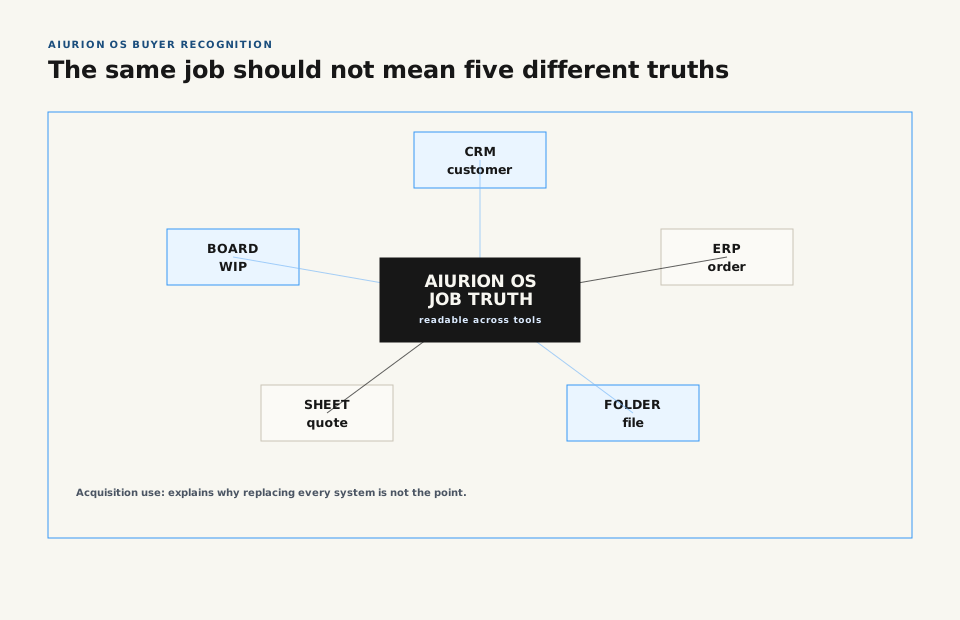
Diagram: The software categories can be correct while the job remains fragmented between them.
Use The Decision Guide
Start with the business constraint that is actually costing the shop time, margin, or control.
Choose ERP Depth When Enterprise Control Is The Constraint
ERP should be the center of gravity when the business needs stronger accounting, purchasing controls, inventory valuation, formal planning, multi-site governance, or finance-led reporting. An operating layer should not be used to disguise a missing financial or material-planning foundation.
Choose MES Depth When Execution Is The Constraint
MES should be central when the shop needs detailed dispatch, work-center control, machine or labor data capture, operation-level WIP, performance analysis, or tight integration with production equipment. A status board is not a substitute for execution depth.
Choose QMS Depth When Quality Governance Is The Constraint
QMS should be central when the shop needs controlled documents, inspection records, nonconformance and corrective-action workflows, calibration, audit evidence, or regulated quality processes. An operating layer can expose quality state to the job, but it should not bypass quality authority.
Add An Operating Layer When The Handoffs Are The Constraint
An operating layer becomes relevant when the existing systems are individually useful but the same job still loses context between them. Typical signs include:
- quote assumptions disappear before release
- production status does not explain the active blocker
- quality state is invisible to customer communication or closeout
- files and revisions are stored but not tied to the decision they shaped
- the office cannot tell whether physically complete work is ready to ship or invoice
- managers still rebuild status through meetings and messages
This is the boundary AIURION is designed to address. It is not a claim that the other systems are obsolete.
When Another Operating Layer Is Unnecessary
Do not add another system merely because the current stack has more than one product.
You may not need a manufacturing operating layer when:
- the ERP, MES, and QMS are already integrated well enough that one job can be traced from customer request through invoice
- the pain is narrow and can be fixed by configuring the system you already own
- the real gap is accounting, MRP, machine connectivity, or formal quality control rather than cross-system handoffs
- the shop has not assigned owners or operating rules for the workflow it wants software to coordinate
- the proposed layer would duplicate data without defining which system remains authoritative
This is the most important buyer boundary. If a responsible person can already answer what was promised, what is released, what is blocked, what quality found, and what is ready for the next handoff from the current stack, adding AIURION would create more software rather than more control.
Questions To Resolve Before Buying
Use one live job in the demo. Ask each vendor to show:
- Which system owns the customer order, inventory, cost, and invoice?
- Which system owns release, dispatch, operations, and WIP?
- Which system owns inspection, nonconformance, approval, and quality evidence?
- How does an approved quote assumption reach the traveler or execution record?
- How does a production or quality blocker change the customer update and shipment state?
- Which record is authoritative when two systems disagree?
- Can the shop preserve its ERP, MES, or QMS investment instead of reimplementing it inside another tool?
- What can the proposed system not do?
The final question is often the most revealing. Clear boundaries are a sign of product maturity. A vendor that claims to replace everything should be required to prove every responsibility it is taking on.
Where AIURION OS Fits
AIURION OS is designed as the live-work operating layer for owner-led and high-mix manufacturing teams. It connects customers, quotes, orders, travelers, production state, blockers, quality history, invoices, team permissions, and AI-assisted review around the job record.
It does not claim to replace every ERP finance control, every MES equipment integration, or every QMS obligation. The practical fit is a shop whose daily pain is the handoff: the software stack contains data, but people still have to reconstruct what is true and what happens next.
Start with the machine shop ERP alternative decision guide if enterprise software scope is the main question. Use the manufacturing operations platform overview to inspect the operating-layer scope. If one real workflow still loses its story between quote, release, production, quality, and closeout, request a focused AIURION pilot around that handoff.
Your Next Move
Do not begin with a software category poll.
Take one job that created confusion and build a four-column ownership map:
| Decision | Current Authoritative System | Secondary System Or Person | Gap To Fix |
|---|---|---|---|
| What did we promise? | |||
| What is released? | |||
| What is running or blocked? | |||
| What did quality decide? | |||
| What can ship or invoice? |
If the authoritative-system column is clear and the handoffs work, improve the stack you have. If ownership is fragmented or every answer depends on a person, that is the operating-layer requirement to evaluate.