
Job Readiness: The KPI That Tells You Whether Work Can Actually Start
Job readiness measures whether planned work can start with the required revision, material, tooling, routing, quality plan, evidence, and ownership.
TL;DR
Job readiness asks whether a manufacturing job can start as planned without a known missing input. It should be evaluated before release, using required gates for the active revision, material, tooling, programming, routing, quality, outside processing, documents, and ownership.
The headline KPI is the percentage of jobs planned for release that pass every required release gate at the planned release time. Do not average a missing drawing with three completed administrative fields. A required red gate makes the job not ready.
AIURION currently provides much of the underlying state through draft Travelers, material and tooling requirements, Production phase gates, blockers, owners, and next actions. It does not currently present a single universal “job readiness percentage,” so the KPI in this article is an operating method, not a claim about a built-in dashboard card.
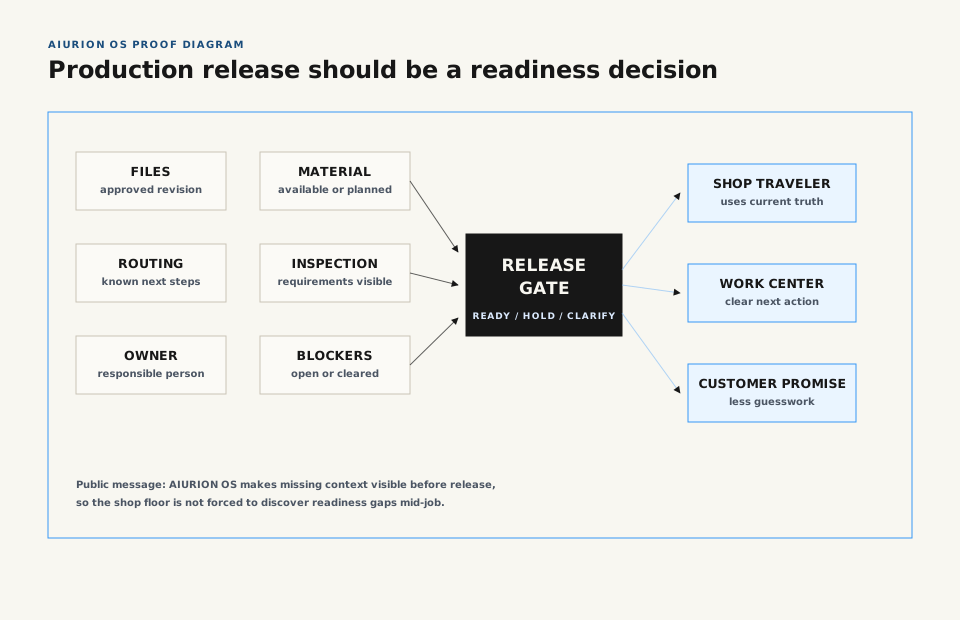
Diagram: Release should follow evidence-backed readiness, not urgency alone.
Skip Ahead
- Define ready precisely
- Copy the release scorecard
- Calculate the KPI without gaming it
- A filled readiness example
- Where AIURION fits today
Define Ready Precisely
A due date does not make a job ready. Neither does an approved quote, an available machine, or a traveler shell.
A job is ready when every input required for its first executable step is either:
- Ready: verified and available;
- Not applicable: explicitly reviewed and excluded; or
- Conditionally accepted: an authorized person has documented the risk, owner, condition, and limit of the release.
Anything else is not ready.
NIST describes production scheduling as allocating activities to resources over time and identifies machines, operators, tools, fixtures, raw materials, and information among the relevant resources [S1]. Job readiness is the release-side check that those inputs and their instructions exist before the schedule treats the job as executable.
This is narrower than broad production planning. It does not decide the optimal sequence for the whole shop. It prevents work from entering that sequence with known holes.
The manufacturing job packet defines what the floor needs to carry the work. Job readiness is the gate that checks whether that packet is sufficiently complete to release.
Copy the Release Scorecard
Use one row per gate. Mark whether the gate is required for this job before scoring it.
| Gate | Required? | State | Evidence | Owner | Needed by | Release blocker or condition |
|---|---|---|---|---|---|---|
| Customer requirement | Yes / No | Ready / At risk / Blocked / N/A | ||||
| Active model, drawing, and revision | Yes / No | Ready / At risk / Blocked / N/A | ||||
| Quote assumptions and exclusions | Yes / No | Ready / At risk / Blocked / N/A | ||||
| Material and certification | Yes / No | Ready / At risk / Blocked / N/A | ||||
| Tooling, fixture, and gauges | Yes / No | Ready / At risk / Blocked / N/A | ||||
| Program and setup plan | Yes / No | Ready / At risk / Blocked / N/A | ||||
| Routing and operation ownership | Yes / No | Ready / At risk / Blocked / N/A | ||||
| Inspection and quality plan | Yes / No | Ready / At risk / Blocked / N/A | ||||
| Outside-process plan | Yes / No | Ready / At risk / Blocked / N/A | ||||
| Supporting documents and access | Yes / No | Ready / At risk / Blocked / N/A |
State definitions:
- Ready: evidence is present and the responsible owner confirms it.
- At risk: evidence or timing is incomplete, but a named conditional-release decision is possible.
- Blocked: a required input is absent, conflicting, rejected, or unavailable.
- N/A: the gate was reviewed and does not apply to this job.
Do not use “N/A” as a shortcut around missing work. Record who reviewed it and why.
Calculate the KPI Without Gaming It
Headline readiness rate
Use a fixed release horizon and a fixed measurement moment:
job readiness rate = jobs passing every required gate at planned release time / all jobs planned for release
A job with a required Blocked gate is not ready. A job with an At risk gate is not counted as ready unless the authorized conditional-release decision is recorded before the measurement moment.
Supporting measures
The headline rate needs diagnostic measures:
| Measure | What it reveals |
|---|---|
| First-pass readiness rate | Whether jobs arrive at release review complete |
| Readiness by gate | Which input fails most often |
| Time from first blocked state to resolution | How quickly the shop closes pre-release gaps |
| Jobs released with accepted conditions | How often the shop knowingly carries risk forward |
| Post-release discovery rate | How often a missing prerequisite is found only after release |
| Planned release date changes | Whether incomplete jobs are being rescheduled instead of resolved |
Avoid universal benchmark targets. The initial target should come from the shop's baseline, product mix, and consequence of bad release. A repeat fabrication shop and a regulated prototype program should not inherit the same number from an article.
Keep the denominator honest
Do not remove hard jobs from the planned-release set after they fail. Preserve the original planned release time and report any reschedule separately. Otherwise the metric rewards moving the goalposts.
A Filled Readiness Example
This example is illustrative, not a claimed AIURION customer result.
Job J-1042 is planned for release Thursday at 2:00 PM.
| Gate | Required? | State | Evidence | Owner | Needed by | Release blocker or condition |
|---|---|---|---|---|---|---|
| Customer requirement | Yes | Ready | Approved quote v3 and customer PO | Estimator | Complete | None |
| Active revision | Yes | Blocked | Rev D drawing; model still labeled Rev C | Engineering | Thu 11:00 | Resolve controlling model before release |
| Material | Yes | At risk | Stock allocated; cert pending | Purchasing | Thu noon | Conditional release may allow programming only, not setup |
| Tooling | Yes | Ready | Fixture F-12 and gauge listed | Planner | Complete | None |
| Program and setup | Yes | Ready | Program path and setup notes in draft traveler | Programmer | Complete | None |
| Routing and ownership | Yes | Ready | Three operations with assigned workcenters | Planner | Complete | None |
| Quality plan | Yes | Blocked | Prior-job checks copied; Rev D features not reviewed | Quality | Thu 1:00 | Current-revision review required |
| Outside process | Yes | Ready | Anodize vendor and planned handoff recorded | Purchasing | Complete | None |
At the measurement moment, this job is not ready. Two required gates are Blocked. The material gate is not automatically a release failure if an authorized person records a limited condition, but that condition cannot override the unresolved configuration and quality-plan conflicts.
This example also shows why a weighted score can mislead. Six green rows do not neutralize the wrong model.
Use Readiness as a Learning Loop
The KPI should improve the handoff, not punish the person who reports the problem.
Run a short weekly review:
- Which jobs missed first-pass readiness?
- Which gate failed first?
- When could the shop have known?
- Did the defect begin in RFQ, quote, planning, purchasing, or quality?
- What one field, rule, owner, or review would prevent recurrence?
If the same gate fails repeatedly, fix the upstream workflow. Do not add another reminder at release.
For the controlled action boundary—who may hold, release, or accept a condition—use the system-of-record versus system-of-action canvas.
Where AIURION Fits Today
AIURION's current workflow supports readiness in two stages.
Before release
A draft Traveler can carry:
- part number, revision, quantity, customer, PO, due date, and source analysis;
- routing, operations, workcenters, machines, programs, fixtures, setup notes, tools, and inspection flags;
- material and tooling requirements with status, owner, notes, and ETA;
- documents and a QC plan.
The release action turns the routing into executable operations and sends the job to Production and Scheduling. The article's scorecard is a recommended review over those inputs; it is not a claim that AIURION currently computes every row into a universal pre-release score.
After release
Production currently provides explicit gates:
- Material, Tooling, and Programming precede Setup;
- Setup precedes Operations;
- Operations precedes QC;
- QC precedes Packaging.
Material and Tooling roll up from requirement rows with owners and statuses. Production shows blockers, phase health, and the next action. Those states can support a readiness baseline while keeping traveler execution and history in the full work packet.
For the operator-facing record, see paperless shop travelers. For supervisor visibility after release, see job shop production tracking.
Recommended Next Move
Score every job planned for the next release window once, using the table above. Record the first failed gate and the point where the shop could have known.
If the same gate repeatedly breaks between order, traveler, and production, request a focused AIURION job-readiness pilot around that one release path.
References
[S1] NIST - Unified Process Specification Language: Requirements for Modeling Process (NISTIR 5910) [Link]