
Manufacturing Data Cleanup: Start With the Job, Not the Database
The useful manufacturing cleanup backlog is not every imperfect field. It is the set of data defects that change live job decisions.
TL;DR
Do not begin manufacturing data cleanup by exporting every table and arguing about field standards.
Begin with one recent job. Reconstruct the records required to quote, release, run, inspect, explain, ship, and invoice it. Classify each defect as missing, stale, duplicate, conflicting, malformed, or orphaned. Correct the defects that can change a live decision, then add one prevention rule for each recurring cause.
This article is about operational cleanup, not a full ERP migration or enterprise master-data program. The deliverable is a prioritized, owned cleanup backlog tied to real work.
Skip Ahead
- Keep the scope operational
- Classify the defect before fixing it
- Copy the job cleanup worksheet
- A filled cleanup example
- Where AIURION fits today
Keep the Scope Operational
Manufacturing data cleanup can expand without limit:
- customer and vendor duplicates;
- item-master conventions;
- old routings;
- inconsistent machine names;
- document naming;
- obsolete spreadsheets;
- inventory units;
- incomplete quality records;
- years of historical notes.
All of those may matter. They do not all deserve equal priority.
The first filter is decision impact:
Could this defect change price, lead time, revision, release, routing, material, inspection, customer communication, shipment, or invoice state on active or repeat work?
If yes, put it in the operating cleanup queue. If no, park it in a separate migration, archive, analytics, or master-data backlog.
NIST's digital-thread work emphasizes structured, traceable exchange of product and manufacturing information across lifecycle activities [S1]. A job-first cleanup applies that principle to the records a shop actually needs today.
For the authority model behind the cleanup, start with the manufacturing source-of-truth audit. This article assumes the shop has named which record should control; cleanup makes the actual records conform to that decision.
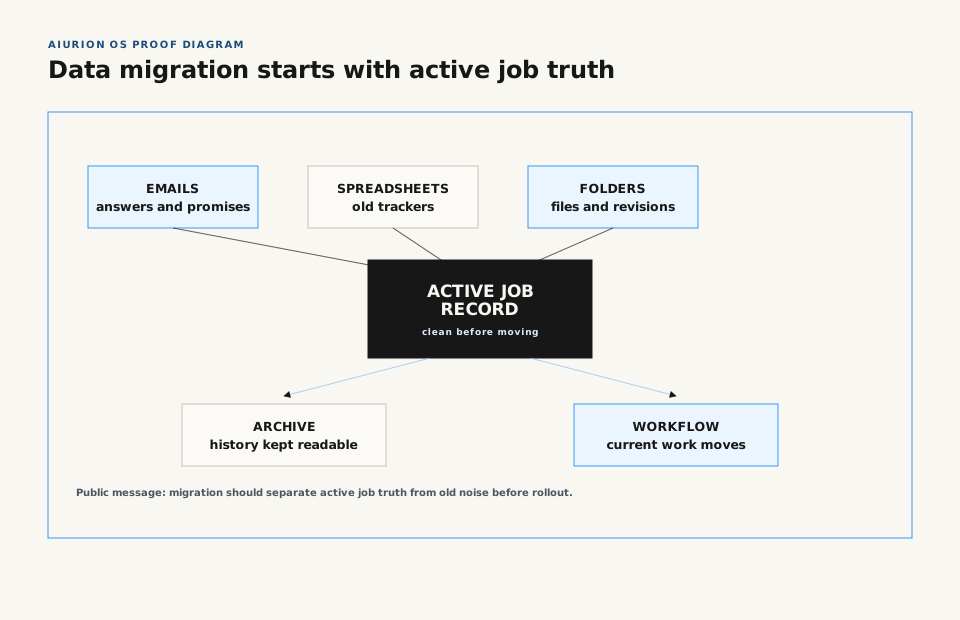
Diagram: Stabilize active and repeat-job truth before carrying old noise into a new system.
Classify the Defect Before Fixing It
Different data defects need different remedies.
| Defect | Meaning | Example | Corrective action |
|---|---|---|---|
| Missing | A required value or record does not exist | No inspection requirement on the current traveler | Add from an authoritative source and assign ownership |
| Stale | A once-valid value no longer reflects current state | Material ETA passed without update | Reconfirm or mark unknown; do not preserve false precision |
| Duplicate | Two records represent the same entity or event | Two client records for the same company | Select the survivor, merge required context, retire the duplicate |
| Conflicting | Two records claim different controlling answers | Quote says Rev D; traveler attachment is Rev C | Escalate to the authority, disposition the loser, preserve history |
| Malformed | The value exists but cannot be used reliably | Quantity entered in a free-text note | Normalize into the intended field with units |
| Orphaned | A record has lost its job or entity relationship | Inspection PDF stored with no order or traveler link | Attach to the correct record or archive with reason |
This classification prevents a common mistake: treating every mismatch as a formatting problem. A revision conflict is a decision requiring authority. It is not safe to resolve it with a bulk string replacement.
Copy the Job Cleanup Worksheet
Choose one active or recently completed job that required repeated follow-up. Use one row per defect.
| Job decision | Required record | Defect class | Current location | Authoritative source | Business consequence | Correction | Owner | Due | Prevention rule |
|---|---|---|---|---|---|---|---|---|---|
Work the sheet in four passes.
Pass 1: Capture without fixing
Follow the job from request to invoice and list every point where someone searched, asked, reconciled, re-entered, or guessed. Do not redesign the system during discovery.
Pass 2: Establish authority
For each defect, name the source that is allowed to resolve it: approved customer communication, released engineering, approved quote version, traveler, inspection result, shipping record, or posted invoice.
Pass 3: Correct and verify
Make the smallest safe correction. Confirm that downstream users now see the controlling value. Preserve the superseded record where history matters.
Pass 4: Prevent recurrence
Add a control at the point of creation: required field, naming rule, owner, validation check, relationship constraint, review gate, or archive rule. Cleanup without prevention becomes recurring clerical work.
A Filled Cleanup Example
This example is illustrative, not a claimed customer result.
The team reconstructs repeat job J-1042 and finds four defects:
| Job decision | Required record | Defect class | Current location | Authoritative source | Business consequence | Correction | Owner | Due | Prevention rule |
|---|---|---|---|---|---|---|---|---|---|
| Which revision controls? | Released drawing | Conflicting | Rev C in shared folder; Rev D in customer email | Engineering-approved Rev D | Wrong setup or inspection | Attach Rev D to traveler; mark Rev C superseded | Engineering | Before release | Traveler release check must confirm file/revision pair |
| Is material ready? | Material requirement and ETA | Stale | ETA from last week | Supplier acknowledgement | False green release state | Reconfirm ETA and set requirement to Blocked | Purchasing | Today | Require next-follow-up date with non-ready material |
| Who owns outside process? | Vendor and owner | Missing | Estimator note only | Approved quote basis | No follow-up ownership | Add vendor step and purchasing owner | Planner | Before routing approval | Outside-process assumption becomes routing/release field |
| What did inspection find? | Current inspection result | Orphaned | PDF in quality folder | Inspector-signed report | Status cannot be verified from job | Link report to current traveler history | Quality | Before closeout | Inspection upload requires order/traveler relationship |
This is a real cleanup backlog: four corrections, four owners, four prevention rules. “Clean all legacy files” is not.
What to Clean First
Use this order when multiple defects compete:
- Safety, contractual, regulatory, or customer acceptance risk
- Active revision and requirement conflicts
- Release and execution blockers on current work
- Commercial assumptions that affect margin or due date
- Quality and closeout evidence needed for shipment or invoice
- Repeat-job records likely to be reused soon
- Reporting consistency and historical cosmetics
Do not delete history merely because it is old. Archive and deletion are different actions. Keep what the business, customer, contract, or quality process requires, and make the active record unambiguous.
Cleanup Is Necessary for AI, but It Is Not an AI Project
An assistant can summarize only the context it can locate and access. It can also spread stale or conflicting information more fluently if governance is weak.
The NIST AI Risk Management Framework is a voluntary, use-case-agnostic framework for managing AI risk and incorporating trustworthiness into design, use, and evaluation [S2]. For a shop-floor assistant, reliable and governed source records are a practical prerequisite—not a guarantee that every output is correct.
Use AI after authority and access are defined:
- flag a missing field for review;
- compare records and identify a conflict;
- summarize a job with citations back to the record;
- propose a normalized label;
- draft a cleanup task.
Keep a person responsible for merging customers, changing a controlling revision, disposing a quality record, or accepting a commercial assumption.
Where AIURION Fits Today
AIURION does not currently offer a magic “clean my manufacturing database” operation, and this article should not imply one.
The useful current surfaces are where clean operating data is created and maintained:
- Clients for customer companies, contacts, notes, documents, and tags;
- Reports for part-analysis records and their relationship to Quotes or Orders;
- Quotes for client, line items, notes, status, and version history;
- Orders for the customer job and its production/invoice relationships;
- Travelers for revision, routing, material, tooling, documents, QC, execution, and history;
- Production for requirement statuses, blockers, owners, phase notes, and next actions.
A focused implementation should choose one recurring defect, correct the live records, and install the prevention rule at the relevant handoff. It should not begin by importing every historical spreadsheet.
Recommended Next Move
Complete the job cleanup worksheet for one messy active or repeat job. Correct the highest-risk conflict and add its prevention rule before expanding the backlog.
If the same defect crosses Reports, Quotes, Orders, or Travelers, request a focused AIURION data-cleanup pilot around that handoff.