
Manufacturing Source of Truth: The Job Record That Runs the Shop
A manufacturing source of truth is not one giant database. It is a governed job record that lets the next person verify the current state and act without reconstructing it.
TL;DR
A manufacturing source of truth is not a promise that every field lives in one database. It is a governed answer to the questions that move a job: what the customer requested, what the quote assumed, which revision controls, what was released, what is blocked, what passed inspection, and what is ready to ship or invoice.
Each answer needs an authoritative record, supporting evidence, an owner, and a visible history when it changes. Without those controls, a dashboard only displays whichever version of the story reached it first.
AIURION's current product surface connects the job across Reports, Quotes, Orders, Travelers, Production, Scheduling, and Invoices. The practical test is whether those handoffs preserve the promise and proof—not whether the shop can claim it owns one perfect database.
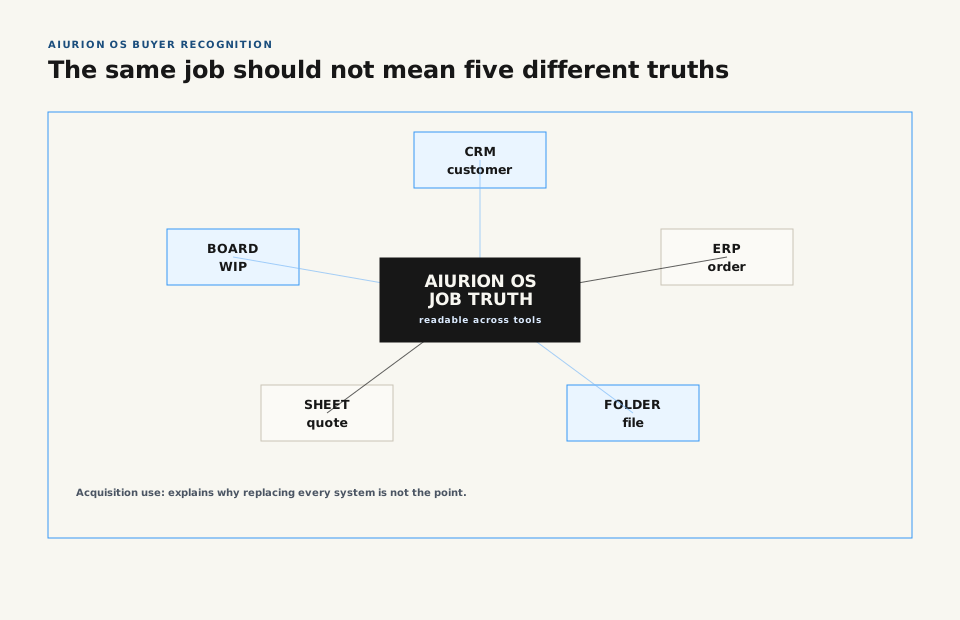
Diagram: The problem is not having multiple tools. It is allowing the same job to develop multiple controlling stories.
Skip Ahead
- Define truth at the decision level
- What the job record needs
- Run the one-job truth audit
- A filled audit example
- Where AIURION fits today
Define Truth at the Decision Level
“Put everything in one system” sounds decisive and usually collapses under real shop work.
The accounting system may remain authoritative for posted invoices. The drawing vault may remain authoritative for released engineering. A quality system may control a specific inspection record. The source-of-truth problem is not automatically solved by replacing all three.
The more useful question is:
For this decision, which record controls—and can the next person reach it from the job?
NIST's digital-thread research focuses on the exchange, reuse, and traceability of information across engineering, manufacturing, and quality functions [S1]. ISA-95 similarly defines an integration boundary between enterprise functions and manufacturing operations rather than declaring that one application must own every layer [S2].
For a high-mix shop, the operating version is straightforward:
- one job identifier follows the work;
- each decision has a named authoritative field or record;
- supporting files and evidence are attached or linked;
- changes preserve actor, time, reason, and prior state;
- conflicting answers are surfaced instead of silently merged;
- access follows the user's role and need.
That is a source of truth people can operate from.
What the Job Record Needs
The job record should be complete enough to support the next decision, not inflated with every field the business has ever collected.
| Decision area | Controlling question | Minimum evidence |
|---|---|---|
| Customer request | What did the customer actually ask us to make and deliver? | Customer, contact, request, files, quantity, target date |
| Quote basis | What facts and assumptions created price and lead time? | Quote version, line items, notes, exclusions, approval state |
| Configuration | Which model, drawing, revision, and specification control? | Released identifiers plus the authoritative files |
| Release | Has the work packet been reviewed and released? | Traveler state, routing, material, tooling, documents, QC plan |
| Execution | What operation is active and what has completed? | Operation status, assignment, quantities, scrap, signoff |
| Blocker | Why can the job not advance? | Blocker type, owner, next action, timestamp, expected resolution |
| Quality | What inspection is required and what result exists? | Inspection plan, status, measurements, disposition, inspector |
| Commercial closeout | Can the job ship, fulfill, and invoice? | Packaging/shipping state, invoice relationship, remaining hold |
| Access | Who may view or change each record? | Organization role and permission boundary |
The important word is “controlling.” A PDF in email and a file in the traveler can both exist, but they cannot both silently claim to be the active revision.
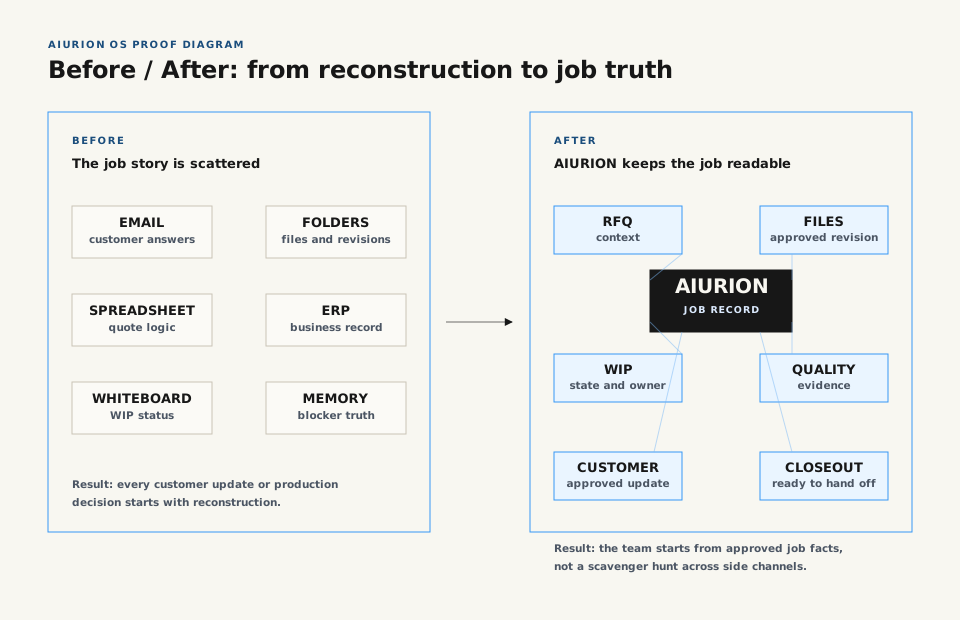
Diagram: Connected handoffs preserve a job story; they do not erase the systems that still own specialist records.
Run the One-Job Truth Audit
Choose one active job with a normal amount of friction: a revision, material dependency, outside process, inspection requirement, or customer update. Audit decisions, not applications.
Copy this table into a worksheet:
| Decision | Current answer | Authoritative record | Supporting evidence | Owner | Last changed | Conflict or gap |
|---|---|---|---|---|---|---|
| What did we promise? | ||||||
| Which revision controls? | ||||||
| Is the traveler released? | ||||||
| What is blocking progress? | ||||||
| What operation is active? | ||||||
| What quality evidence exists? | ||||||
| What should the customer hear? | ||||||
| Can the job ship and invoice? |
Grade each row:
- Verified: one controlling answer points to current evidence.
- Stale: an answer exists, but its age or upstream change makes it unreliable.
- Conflicted: two records disagree and neither has been dispositioned.
- Missing: the decision depends on memory or a new search.
- Unauthorized: the answer exists, but the responsible person cannot access it.
Do not average those states into a vanity score on the first pass. The list of conflicted and missing decisions is already a usable operating backlog.
A Filled Audit Example
This example is illustrative, not a claimed AIURION customer result.
Job J-1042 is a repeat machined housing due next Friday.
| Decision | Current answer | Authoritative record | Supporting evidence | Owner | Last changed | Conflict or gap |
|---|---|---|---|---|---|---|
| What did we promise? | 24 housings, ship Friday | Approved quote v3 | Quote PDF and approval event | Estimator | Monday | Verified |
| Which revision controls? | Rev D | Traveler overview | Rev D drawing attached to traveler | Engineering | Tuesday | Email still contains Rev C; mark superseded |
| Is the traveler released? | Draft | Traveler status | Routing and QC plan incomplete | Planner | Tuesday | Missing release decision |
| What is blocking progress? | Material cert not received | Material requirement row | Supplier acknowledgement | Purchasing | Wednesday | Owner and next follow-up present |
| What quality evidence exists? | Prior-job inspection only | Current traveler QC plan | No current result yet | Quality | Wednesday | Correct for pre-release state |
| Can the job ship and invoice? | No | Production and order state | Material and release gates open | Operations | Wednesday | Verified |
This audit exposes three different tasks:
- remove or label the superseded Rev C file;
- finish the current routing and QC plan before release;
- follow the material-cert blocker without inventing a new job status.
That is more useful than a general directive to “clean the data.” It names the decisions at risk.
Governance Rules That Keep Truth from Splitting Again
Name the authority
Write down which record controls each decision. “The system” is not specific enough.
Separate facts, assumptions, and decisions
“Customer requested Friday” is a fact. “We can hold Friday if plating confirms by Tuesday” is an assumption-backed commitment. Do not flatten them into one date field without the condition.
Preserve history instead of overwriting context
When a revision, date, owner, or disposition changes, retain who changed it, when, and why. The old value may no longer control, but it remains part of the job history.
Make conflicts visible
Automatic synchronization can spread a bad value quickly. A safer workflow flags disagreement, identifies authority, and records the resolution.
Keep role boundaries explicit
The operator, estimator, customer contact, and accounting user do not need identical visibility or edit rights. Connected truth still needs permissioned access.
Where AIURION Fits Today
AIURION does not need to replace every specialist system to improve the operating record.
The implemented workflow currently provides these connections:
- Reports stores part-analysis results and can attach them to a Quote or Order.
- Quotes carries client, line items, totals, notes, review state, versions, and conversion history.
- Orders becomes the customer-job record and connects accepted work to a traveler and invoice workflow.
- Travelers hold the executable work packet: part and revision, operations, materials, tooling, documents, QC plan, assignments, results, corrections, and history.
- Production summarizes released work by due date, phase health, blockers, owners, quantities, and next action.
- Scheduling plans open operations from released travelers.
- Invoices remains the billing record linked to commercial closeout.
That is the current product truth. The recommendation in this article—an explicit authority map for every decision—is an operating discipline to apply across those surfaces, not a claim that every outside record is automatically reconciled.
This is also the safe foundation for AI. The Assistant can use permissioned workspace context to summarize work or draft an update. People still own release decisions, corrections, and customer commitments.
For the category boundary, see what a manufacturing operating system should coordinate. For the executable floor record, see what belongs in a manufacturing job packet.
Recommended Next Move
Run the one-job truth audit on a job that must move this week. Fix the first conflicted decision before adding another dashboard or migration scope.
If the conflict sits between two live handoffs, request a focused AIURION operating-record pilot around that specific workflow.